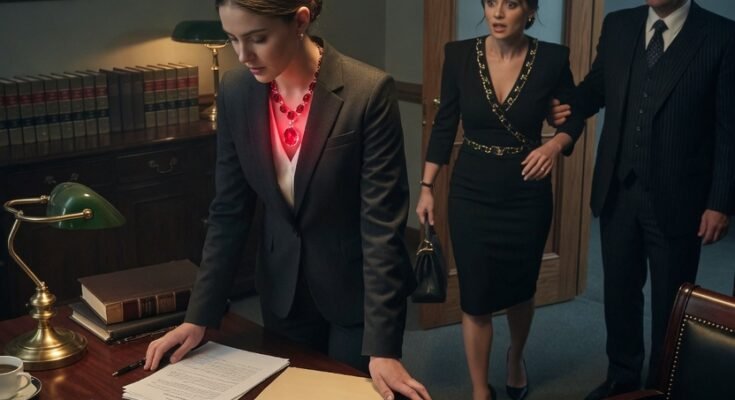
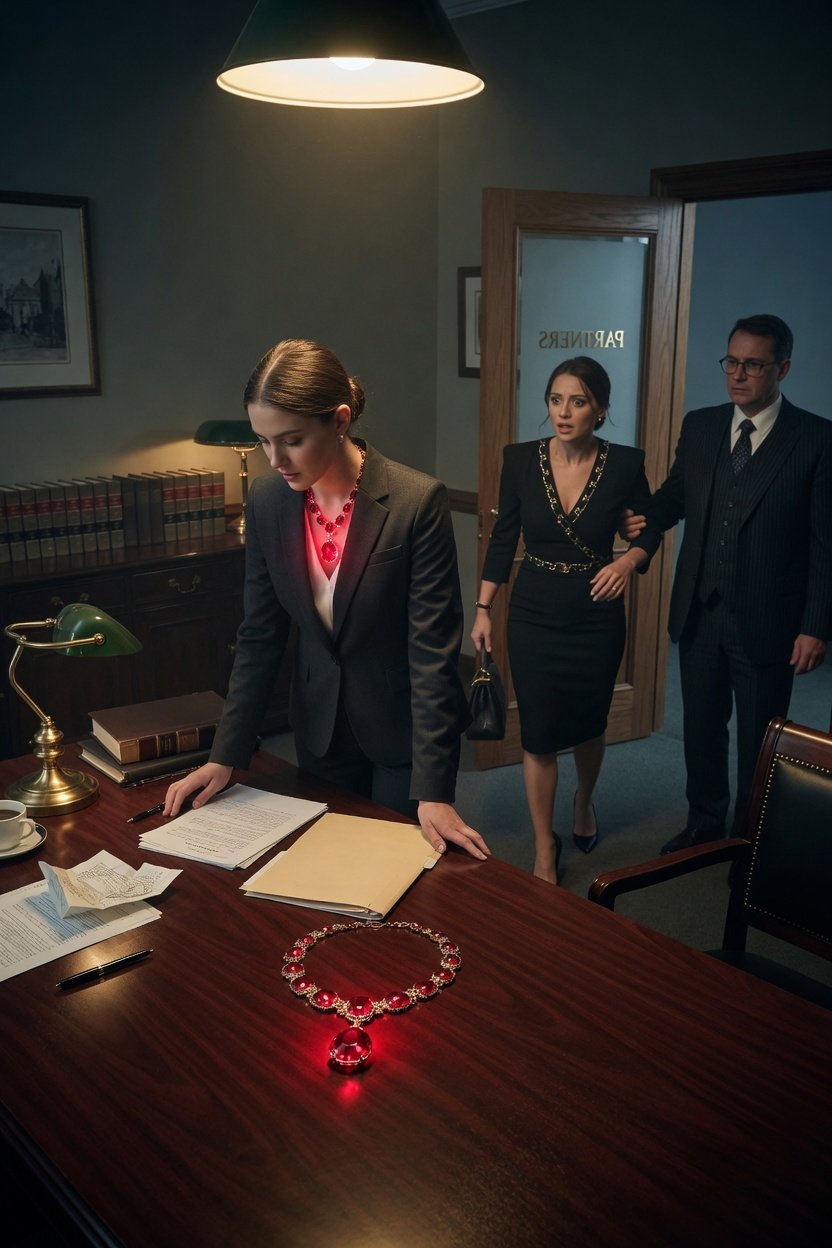
Two weeks later, we gathered in the mahogany-paneled office of Mr. Henderson, my grandmother’s longtime attorney and closest confidant. Brenda arrived wearing a designer black dress that probably cost more than my first car, purchased, no doubt, with the “liquidation” money from the rubies. She sat at the head of the table, already acting like the mistress of the manor. My father sat beside her, looking uncomfortable but subservient.
Mr. Henderson cleared his throat and looked directly at Brenda. “Before we begin the distribution of assets,” he said, his voice as dry as parchment, “I have been instructed to address a specific event that occurred on the day of the funeral. It has come to my attention that a Burmese ruby necklace was removed from the estate safe and sold.”
Brenda straightened her posture, her face a mask of fake concern. “Yes, Leonard. It was a difficult decision, but as the executor’s wife, I felt it was necessary to cover the immediate costs of the burial. Rose would have wanted the family to be unburdened.”
Mr. Henderson smiled, but there was no warmth in it. “That is interesting, Brenda. Because the necklace you sold—the one in the safe—was a high-quality costume replica. Rose moved the genuine rubies to a secure bank vault three months ago, shortly after your wedding to her son.”
The color drained from Brenda’s face. My father looked confused. “A replica? But the appraiser said—”
“The appraiser you contacted was likely fooled by the craftsmanship,” Henderson interrupted. “However, the ‘private collector’ you sold it to has already contacted my office. They are threatening a massive lawsuit for fraud and misrepresentation. They paid six figures for gold-plated glass.”
Brenda began to stammer, but Henderson wasn’t finished. He pulled a heavy folder from his desk. “Rose added a very specific codicil to her will after she noticed things ‘going missing’ from her house during your weekend visits. It’s called an ‘Integrity Clause.'”
He began to read from the document. “If any heir, or the spouse of any heir, attempts to sell, hide, or liquidate any asset belonging to the estate prior to the formal reading of the will, that heir shall be immediately and irrevocably disinherited. Their portion shall be forfeited in its entirety to the secondary beneficiary.”
The silence in the room was deafening. My father looked at Brenda with a mixture of horror and realization. He had allowed her to gamble away his entire inheritance.
“The secondary beneficiary,” Henderson continued, looking at me with a wink, “is Rose’s granddaughter. This includes the manor, the investment portfolios, and, of course, the authentic ruby necklace currently held in the bank vault.”
Brenda erupted. “This is a setup! That old bat trapped me! You can’t do this!” She turned to my father, screaming at him to “do something,” but for the first time in a year, my father looked disgusted. He saw the greed for what it was. He realized that Brenda hadn’t been “managing” the estate; she had been looting it.
In the end, Brenda didn’t just lose the money from the fake necklace—which she had to pay back along with legal penalties—she lost everything. Because she had acted as my father’s agent in the sale, the law treated their interests as one. My father was left with a small monthly stipend, barely enough for a modest apartment, while Brenda was left with nothing but the threat of a fraud charge hanging over her head.
As they were escorted out of the office, I stayed behind. Mr. Henderson handed me a small, velvet box. Inside, the real rubies glowed like embers in the dim light. Attached to the lid was a small note in Rose’s elegant handwriting: *’For my girl, who knows that some things are worth more than gold. Wear them with pride, and never let the vultures win.’*
I put the necklace on, feeling its weight—not as a burden, but as a shield. I walked out of that office into the sunlight, finally at peace, knowing that the woman who tried to sell my history had ended up with nothing but a glass imitation of a life.
Watch movie:

*Content is hosted on a partner site.
