
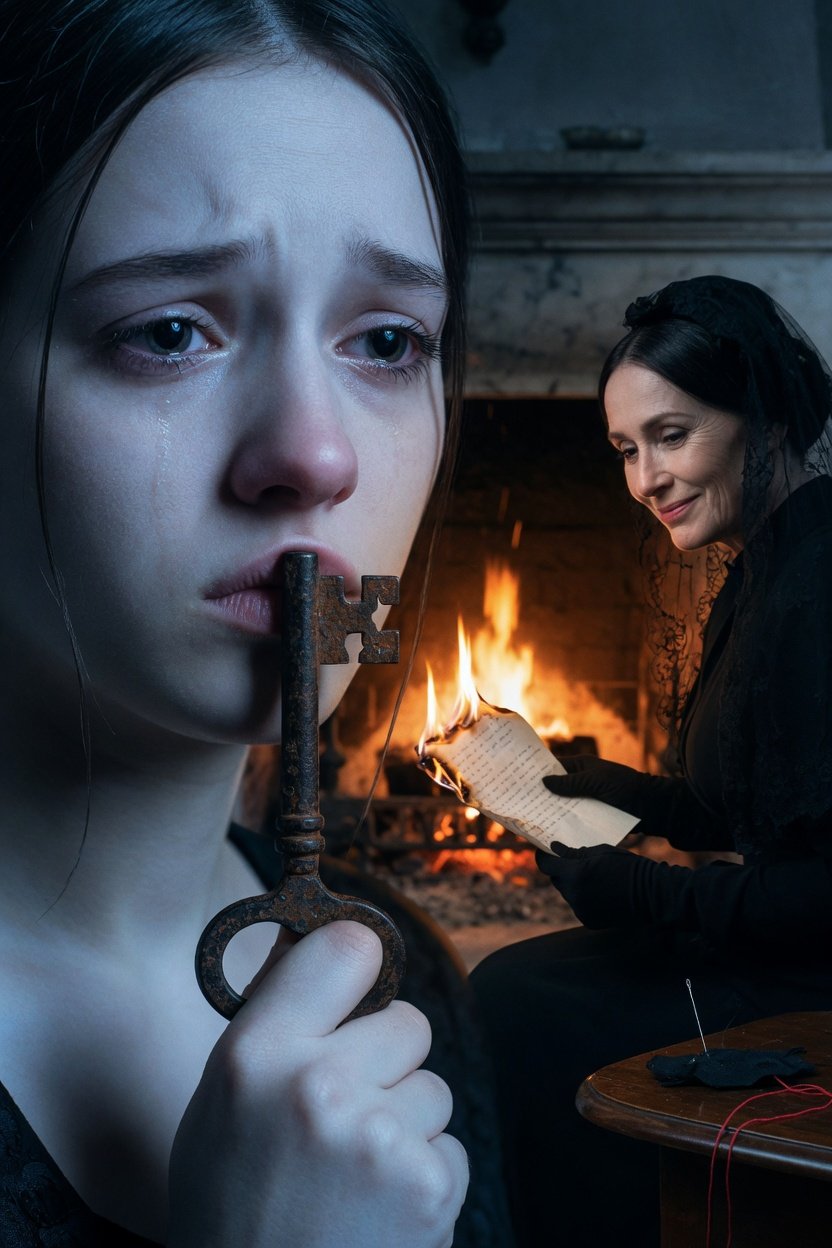
The funeral was a hollow display of wealth. Beatrice stood at the head of the mahogany casket, veiled in expensive black lace, receiving condolences from senators and CEOs. She played the grieving widow perfectly, though I knew her mind was already calculating the liquidation of the shipping line. But the screaming at the gates wouldn’t stop.
The woman from the uncompleted building was frail, her hair a matted silver halo, but her voice carried a haunting resonance. “Elias! You promised me the bridge! You promised me the crossing!” she wailed. Security moved to intercept her, but I stepped forward, blocking their path.
“Let her through,” I commanded. My voice sounded older, colder.
Beatrice snapped her head toward me, her eyes narrowing. “Clara, get that filth away from here. This is a private service.”
“It’s what Dad wanted,” I replied, my heart hammering against my ribs. “He wanted her here. He wrote it in the note you burned.”
The crowd whispered. The mention of a burned note sent a ripple of unease through the board members. To save face, Beatrice had to relent. The “Mad Woman,” whose name I would later learn was Elena, stumbled toward the casket. She didn’t look at the flowers or the grieving family. She looked only at the wood of the coffin.
“He has it,” she whispered, her eyes suddenly clearing of their fog. “He has the key to the vault beneath the hotel.”
Beatrice froze. The “vault” was a legend in our family—the place where the original gold reserves of the shipping line were rumored to be hidden, land deeds that predated the modern corporation. Beatrice had spent ten years trying to find it, but the “uncompleted building” was a labyrinth of booby-trapped concrete and legal red tape.
“There is no key,” Beatrice spat, her composure cracking. “Move her aside.”
But I didn’t move. I looked at Elena. “How do we get it?”
“The crossing requires a debt,” Elena said, her hand reaching out to touch the casket. “He told me he would carry it in his mouth so the usurper couldn’t steal it from his pockets. He said only his blood could retrieve it.”
Beatrice’s face went pale, then red with fury. She realized I had outsmarted her. She lunged for the casket, screaming for the pallbearers to open it, forgetting all about her “dignified” mourning. “If that key is in there, it belongs to the estate! It belongs to me!”
The crowd watched in horror as the “grieving widow” began clawing at the lid of the casket. I stepped back, allowing the scene to unfold. As the lid creaked open, the scent of lilies was replaced by a sharp, metallic odor. Beatrice reached in, her manicured hands searching my father’s cold suit. When she found nothing in his pockets, she looked at his face.
She saw the silk stitch.
With a cry of primal greed, she ripped the thread. The heavy iron key didn’t just sit there; it was wedged deep. As she reached into his throat to pull it out, a loud, mechanical click echoed from beneath the floorboards of the funeral chapel.
My father hadn’t just asked to be taken to the madwoman; he had turned his own body into the final trigger. The “uncompleted building” wasn’t a hotel; it was a tomb built to trap anyone who cared more for the key than the man.
The floor beneath Beatrice and the casket began to tilt. It turned out the family vault was built directly over a secondary basement that connected, via an old tunnel system, to the very building where Elena lived.
“The debt is paid,” Elena whispered as the mechanism groaned.
As Beatrice pulled the key free, she realized too late that the weight of the casket was the only thing holding the trapdoor shut. With the key removed, the counterweight shifted. Beatrice, the coffin, and the key tumbled into the darkness of the shaft below.
I stood at the edge of the pit, looking down into the blackness. Elena took my hand. “She has the key now,” the old woman said, a sad smile on her face. “But she’s in the vault. And the vault only opens from the outside.”
I looked at the “Mad Woman,” who I now realized was my father’s first wife—the woman Beatrice had drugged and driven into the streets twenty years ago to steal her life. I didn’t call the police. I didn’t call for help. I simply took the remaining silk thread from my pocket and walked away with the only mother I had left, leaving Beatrice to count her gold in a room with no doors.
Watch movie:

*Content is hosted on a partner site.
