
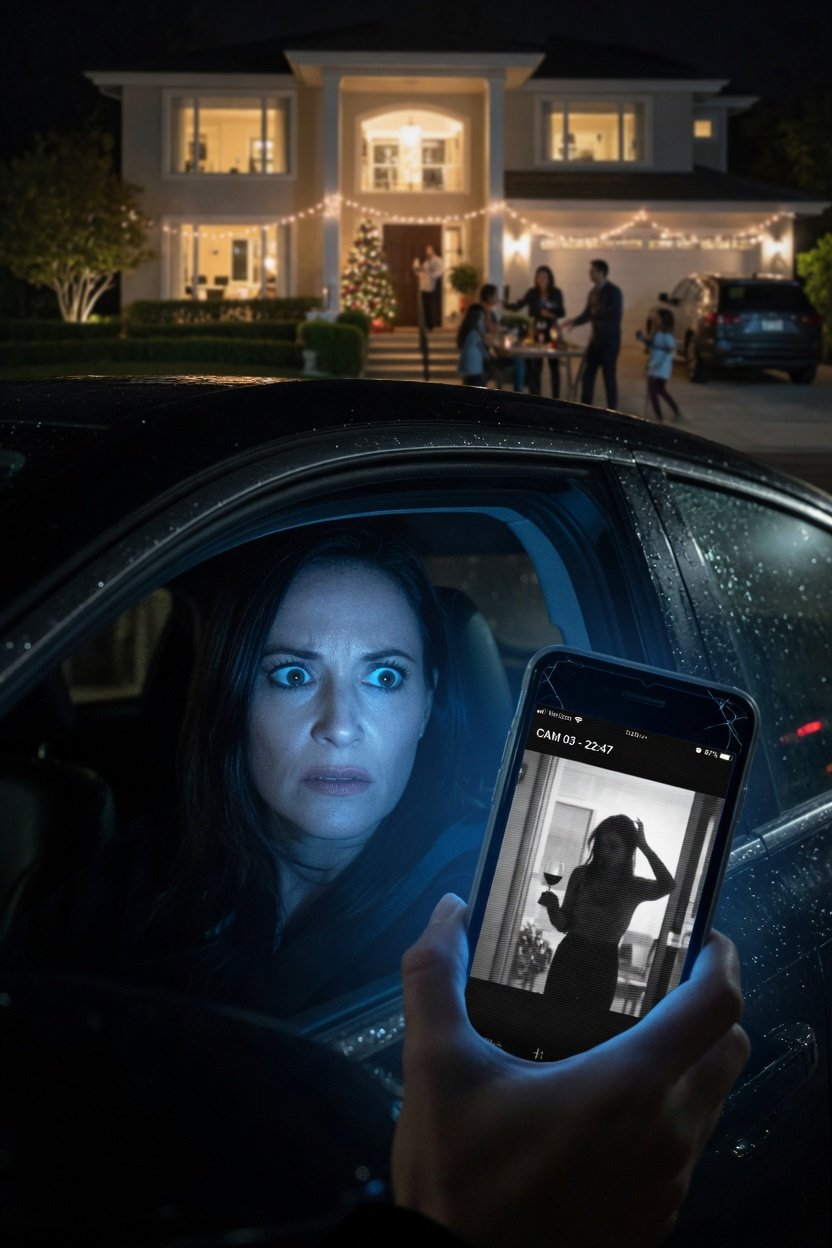
The link I sent didn’t have a caption. It didn’t need one. Within minutes, the neighborhood group chat—a hive of busybodies and family friends—erupted. The video began with Clara in her bedroom, but not looking for a lost bracelet. She was standing in front of a mirror, holding a pair of scissors, methodically shredding a designer dress I had left in their guest room weeks ago. She was whispering to herself, “You think you’re so perfect, Sarah? Let’s see you wear this.”
But that wasn’t the “smoking gun.” The camera then caught her walking into the kitchen as the family began to arrive. She took the gold bracelet out of her own pocket and dropped it into a flower vase in the hallway, not my purse. She then practiced her “sad, victimized face” in the hallway mirror for a full thirty seconds before walking into the dining room to make her grand accusation.
The most damning part of the footage, however, occurred just five minutes before her “discovery.” Clara was on the phone in the pantry, her voice sharp and cold. “I’ve got Mark wrapped around my finger,” she told someone on the other end. “Once I get his sister out of the picture, he’ll sign the power of attorney over to me. He’s so easy to manipulate when he thinks he’s ‘protecting’ me. I’ll have the offshore account cleared by the end of the month, and then I’m filing for divorce. He’ll never see it coming.”
The silence in the dining room must have been deafening as the notifications started chiming on everyone’s phones. I sat in my car at the end of the driveway, watching the house. Suddenly, the front door burst open. Mark came running out, his face pale, clutching his phone like it was a live grenade. My parents followed, looking physically ill.
Clara tried to follow them, screaming that the video was a “deepfake,” but the neighborhood was already responding. Neighbors were peering out of their windows, and the local “moms’ group” was already sharing the link across Facebook. Her reputation, the carefully constructed facade of the perfect, bullied wife, shattered in a matter of seconds.
Mark reached my car window, his eyes red. “Sarah, I… I didn’t know. I’m so sorry. I should have believed you.”
I didn’t roll down the window all the way. “You chose her over your own blood without a single shred of proof, Mark. You called me unstable in front of our parents.”
“I’ll make it right,” he pleaded. “She’s packing her bags. I’m calling a lawyer right now.”
“You do that,” I said calmly. “But don’t do it for me. Do it because you finally realized you were sleeping next to a predator.”
I drove away that night and didn’t answer their calls for weeks. Clara tried to sue me for “invasion of privacy,” but since the cameras were in common areas and I was a registered account holder for the security contract I paid for, the case went nowhere. She disappeared from the neighborhood shortly after, her “friends” having abandoned her the moment the video went viral.
Mark and my parents spent the next year trying to earn back my trust. They learned a hard lesson: the person screaming the loudest about being a victim is often the one holding the knife. As for me, I kept the original footage saved on three different hard drives. I don’t look at it often, but sometimes, when I’m reminded of how easily people can be deceived, I play the clip of Clara practicing her fake tears in the mirror. It serves as a reminder that the truth doesn’t just come out—sometimes, it has to be broadcast.
Watch movie:

*Content is hosted on a partner site.
