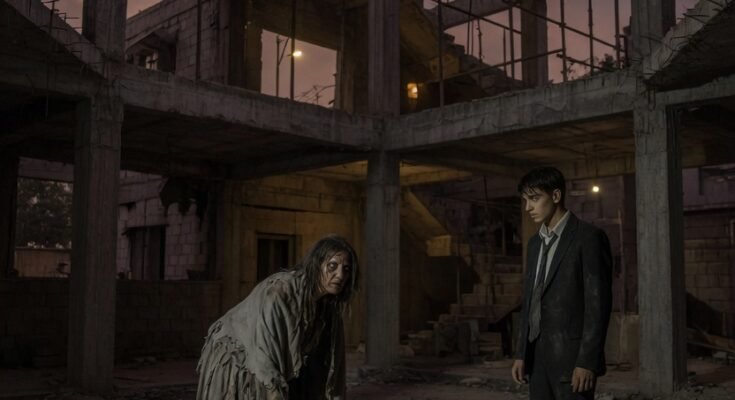
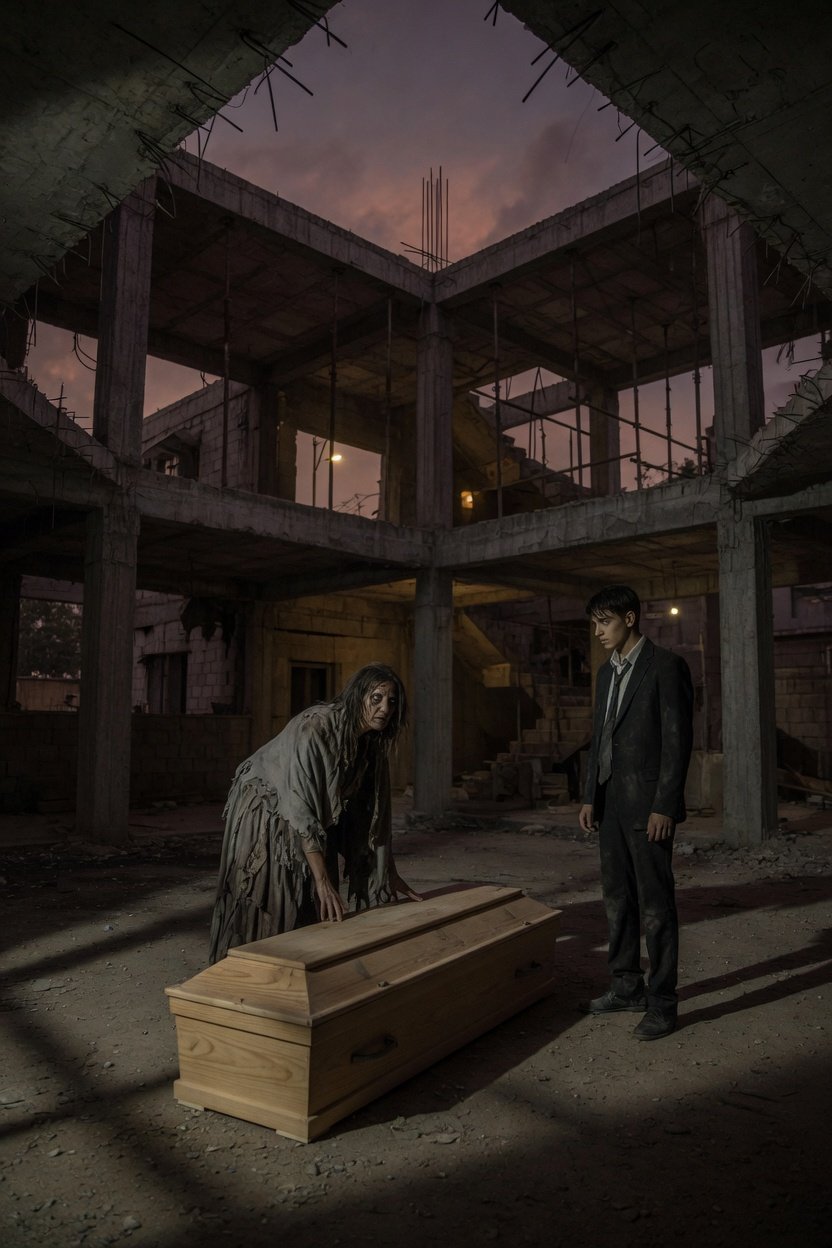
The silence that followed was heavy, broken only by the rhythmic dripping of water from a leaky pipe somewhere deep in the concrete labyrinth. The “Mad Woman” didn’t scream. She didn’t wail. She simply knelt beside the wooden casket and placed a trembling, dirt-stained hand on the lid.
“You finally brought him back,” she whispered, her voice surprisingly melodic despite years of disuse. She looked at me, and for the first time, I noticed the shape of her jaw, the specific arch of her brow. They were identical to mine. A cold realization washed over me, more freezing than the evening air.
“Who are you?” I asked, my voice barely a breath.
She didn’t answer immediately. Instead, she produced a small, rusted key from the folds of her rags and gestured toward the casket. “Open it. Look under his left hand.”
I hesitated, but the mystery was a gnawing hunger. I pried open the lid. My father looked peaceful, his face a mask of waxen stillness. I moved his stiff left hand, and underneath lay an old, yellowed photograph. It was a picture of a young woman, vibrant and beautiful, standing in front of this very building when it was still under construction. She was holding a baby. Beside her stood my father, smiling—a look of genuine joy I had never seen on his face during my entire life.
“This was our dream,” the woman said, her eyes welling with tears that carved tracks through the grime on her cheeks. “He was the architect. I was the financier. We were going to build a future here. But greed is a poison that rots the strongest foundations.”
She began to tell a story that the history books had forgotten. Thirty years ago, a group of powerful investors wanted the land for something else. When my father refused to sell, they didn’t just stop the project; they destroyed their lives. They framed her for a crime she didn’t commit, driving her into a breakdown. My father, threatened with the loss of his only child—me—was forced to renounce her, to tell the world she had died, and to live a life of quiet, miserable compliance to keep me safe.
“He couldn’t save me then,” she said, stroking the wood of the casket. “But he promised that in death, he would return to where our lives ended, so that I wouldn’t be alone in the ruins anymore.”
She reached into the casket and pulled out a heavy envelope tucked into the lining. She handed it to me. Inside were deeds, original titles, and a series of recorded confessions my father had spent decades secretly gathering. He hadn’t been a cold, distant man by choice; he had been a spy in the enemy camp, waiting for the moment his death would trigger the collapse of the men who destroyed our family.
“He knew they would watch him until his last breath,” she explained. “But they wouldn’t watch a dead body being delivered to a ‘mad woman.’ You were the final piece of the puzzle, son. You brought the evidence to the only person who can still use it.”
The “Mad Woman” stood up, her posture straightening, the “madness” vanishing to reveal a sharp, calculating intellect. She wasn’t a victim of her mind; she was a victim of a system, hiding in plain sight, waiting for the ammunition to fight back.
As the police sirens began to wail in the distance—summoned by the very transport drivers I had hired—she didn’t flinch. She handed me a second note, one my father must have hidden even more carefully. It said: ‘Forgive me for the lies. Protect your mother. Finish the building.’
I looked at the skeletal structure around us. It was no longer a tomb or a ruin. It was a mission. My father hadn’t just left me a dead body; he had left me a legacy of justice, hidden in the shadows of an uncompleted dream. We stood together, the woman I had just met and the son she hadn’t held in three decades, watching the flashing lights approach, ready to tear down the empire built on our family’s silence.
Watch movie:

*Content is hosted on a partner site.
