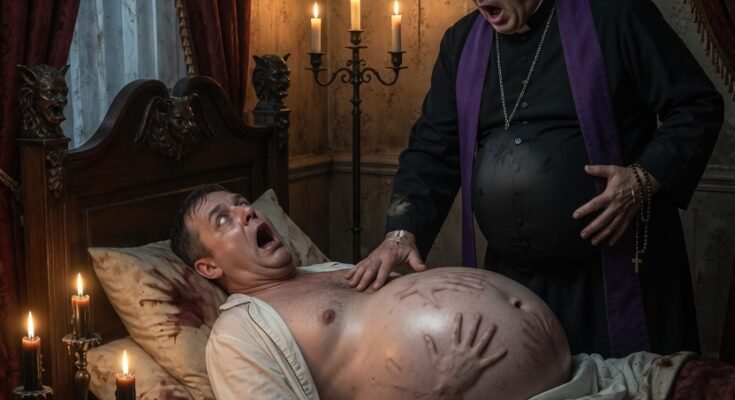
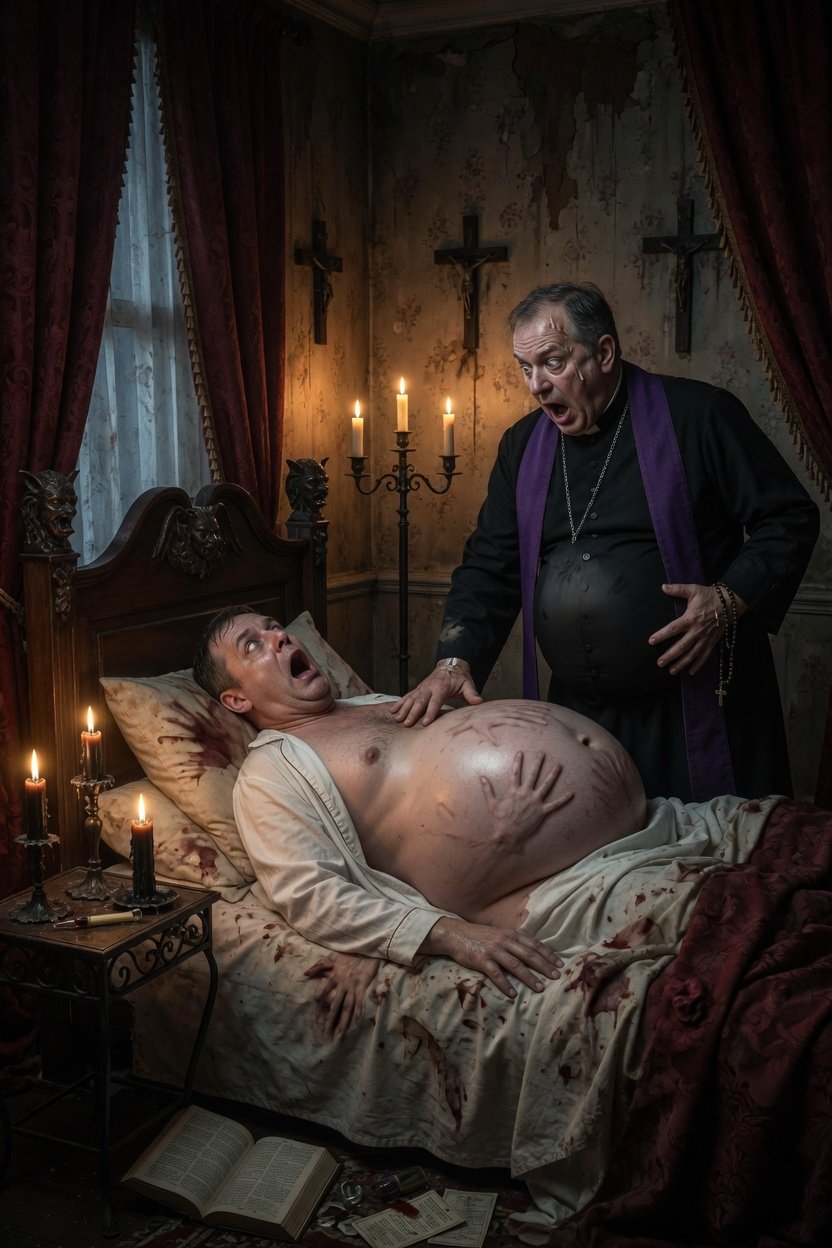
The transition was so rapid it felt like a hallucination. As my husband, Mark, collapsed into a deep, unconscious sleep—his stomach finally flat and his breathing stabilized—Pastor Ezekiel fell to his knees. The transformation was violent. His belt snapped with a sharp crack, and the buttons on his clerical shirt flew across the room like shrapnel. Underneath his vestments, his midsection was ballooning at a rate that seemed to defy the physical limits of human skin. He wasn’t just bloating; he was being filled.
“It is too heavy!” Ezekiel shrieked, clutching his sides. “The weight of the transgression… it is too much!”
I stood paralyzed, caught between the relief of seeing my husband saved and the carnage unfolding before me. Ezekiel’s skin turned a bruised, mottled purple. The same rhythmic thumping that had tormented Mark now echoed through the pastor’s body, but it was louder, more aggressive. It sounded like a drum made of bone. Ezekiel tried to crawl toward the door, his fingers clawing at the wooden floorboards, leaving bloody tracks. He was whispering a confession, words so low I could barely catch them: something about a bargain made forty years ago, a promise of power exchanged for a “vessel” that he had failed to provide.
The village elders, who had been waiting outside, burst in at the sound of the screaming. They stopped dead in their tracks. Ezekiel was now a grotesque caricature of a man, his stomach so large he could no longer see his own feet. He looked up at them, his eyes bloodshot and bulging. “The debt… must be paid… by the one who broke the seal,” he wheezed.
Suddenly, a sickening sound filled the room—the sound of wet parchment tearing. Ezekiel’s skin couldn’t hold the pressure any longer. He let out one final, soul-shattering cry before his body gave way to the internal force. He didn’t just die; he seemed to be consumed from the inside out. When the dust settled and the horrific pressure in the room vanished, there was no “baby,” no parasite, and no mass. There was only the empty husk of a man who had tried to play God with a curse he helped create.
Mark woke up the next morning with no memory of the pregnancy or the ritual. He was weak but healthy. However, the mystery didn’t end with Ezekiel’s burial. When the villagers went to clear out the pastor’s parsonage, they found a hidden cellar beneath his floorboards. Inside were dozens of clay jars, each sealed with wax and marked with the names of families in our village. One jar, marked with my husband’s family name, was shattered.
I realized then that the “mysterious pregnancy” wasn’t a random act of dark magic. It was a stored curse, a manifestation of the village’s sins that Ezekiel had been “collecting” to maintain his own spiritual power. He hadn’t been curing people; he had been bottling their darkness to use as a battery for his miracles. When he tried to cast the curse out of Mark, he didn’t realize that Mark’s bloodline was the original source of the power he had stolen. The curse didn’t just transfer; it returned home to the man who had manipulated it for decades.
Now, months later, the village is quiet, but the fear remains. Mark is back to work, but sometimes at night, I see him staring at his reflection in the mirror, rubbing his stomach with a look of distant confusion. And sometimes, when the wind blows through the trees near the old church, I can still hear the rhythmic, hollow thumping of a heartbeat that has no body to call its own. We survived the impossible, but we learned a bitter truth: when you ask a holy man to fight a demon, make sure he isn’t the one who invited it in for dinner.
Watch movie:

*Content is hosted on a partner site.
