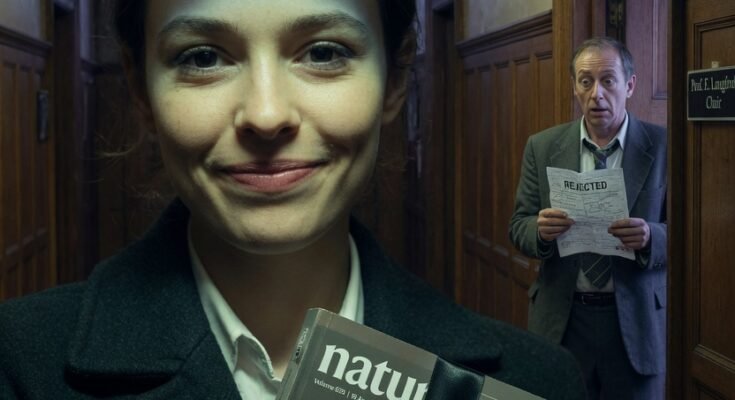
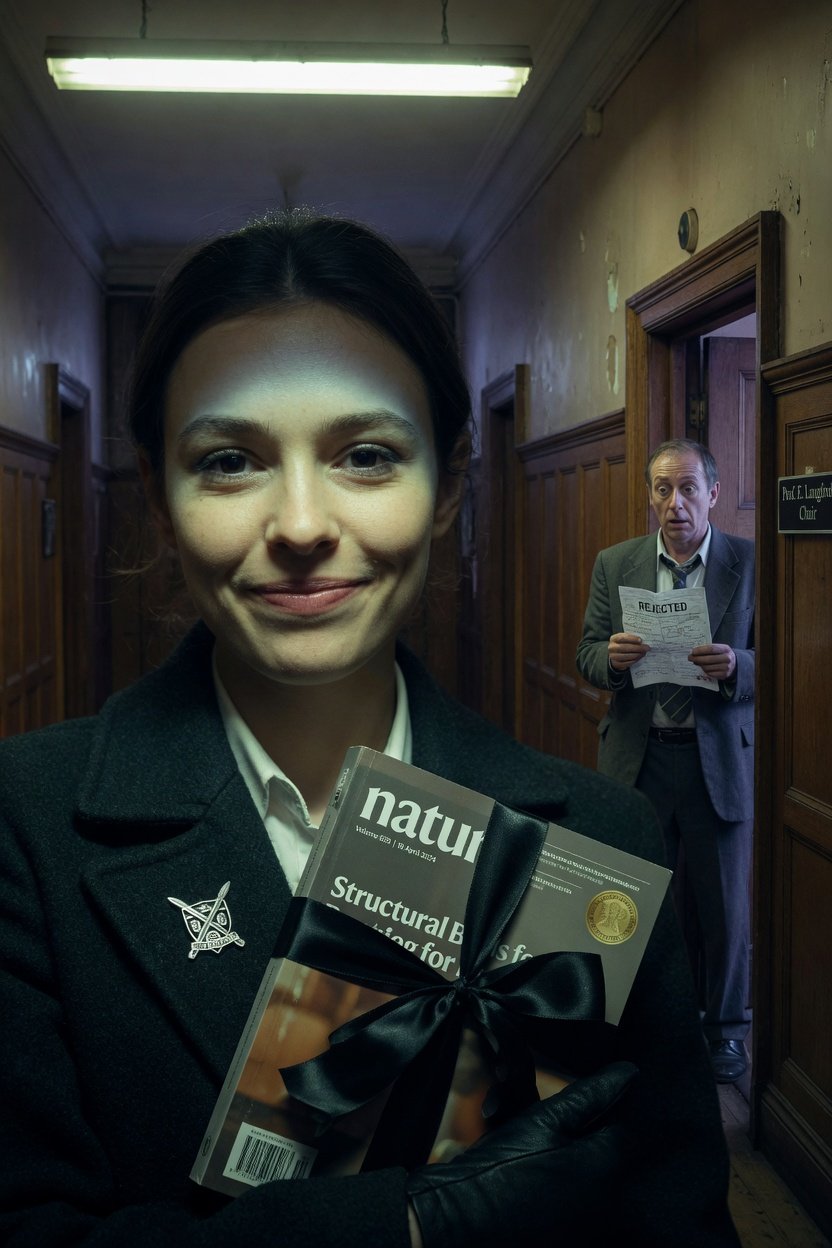
The note was short and precise: “Since you found this work so unoriginal, I thought you wouldn’t mind if I published it under my own name. I’ve taken the liberty of CC’ing the Ethics Board, the Grant Committee, and the University Legal Department on the original timestamped logs.”
I watched from the hallway as Professor Miller entered his office and closed the door. Within ten minutes, I heard a muffled shout, followed by the unmistakable sound of a heavy chair being kicked. He had opened the envelope. He had seen my name, Clara Vance, listed as the lead researcher on a paper that effectively debunked the “findings” his son had used to win the Young Innovator’s Grant.
You see, Professor Miller was arrogant, but he wasn’t smart. He had stolen the version of my paper I turned in for my mid-term—a version that contained a deliberate “poison pill.” I had intentionally skewed three minor variables in that draft, knowing that anyone who tried to replicate the results without the master key in my private logs would end up with a chemical reaction that was not only impossible but scientifically laughable. His son’s award-winning paper was built on a foundation of impossible math that I had planted like a landmine.
By noon, the atmosphere in the science department shifted from celebratory to funereal. The National Science Review had not only published my work but had also released a scathing editorial about “data integrity in undergraduate mentorship,” naming Professor Miller’s lab as the source of a “concerning discrepancy.”
The Dean, who had previously been too busy to look at me, was now calling my cell phone every five minutes. I didn’t answer. I sat in the library, watching the chaos unfold. The Grant Committee revoked the son’s $50,000 award within three hours. By the afternoon, an emergency board meeting was called.
When I finally walked into the Dean’s office, Miller was there. He looked like he’d aged ten years. His face was a sickly shade of gray, and his hands were shaking as he held the journal I had sent him. The black ribbon I had tied around it sat on the desk like a tiny, silk tombstone for his career.
“Clara,” Miller stammered, his voice cracking. “There has been a terrible misunderstanding. We can fix the grade. We can give you a full research fellowship. Just… just tell the journal there was an error in the attribution. Tell them we collaborated.”
I looked at him, feeling a cold, clean sense of peace. “The only error, Professor, was thinking that I was small enough for you to crush. My paper was peer-reviewed by the best minds in the world. They found it quite original. As for the ‘D’ you gave me, keep it. It’s the only thing you have left.”
The fallout was absolute. Professor Miller was forced into a “voluntary” retirement to avoid a full-blown fraud lawsuit. His son was expelled for academic dishonesty, and the university was forced to issue a formal public apology to me. They offered me a full ride for my PhD, but I turned them down. I had already received offers from three Ivy League schools and a private research firm.
As I packed my bags to leave the campus for good, I walked past Miller’s old office. The nameplate had already been removed. I took the “D” paper out of my bag—the one with his red ink all over it—and taped it to the door. Underneath his “unoriginal” comment, I wrote one last thing: “Published. Page 1.” I left the building without looking back, the weight of the world finally off my shoulders.
Watch movie:

*Content is hosted on a partner site.
