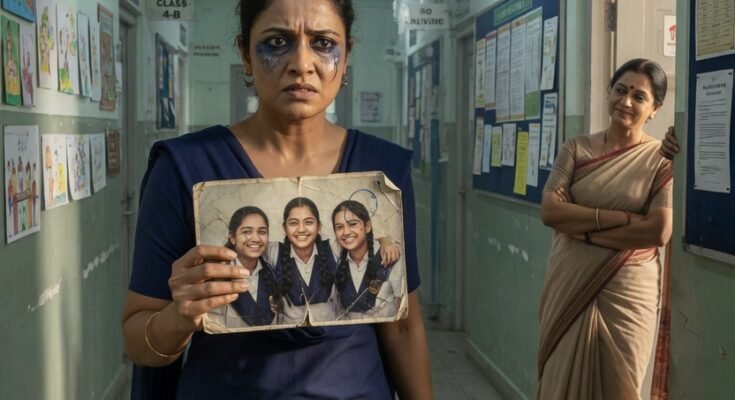
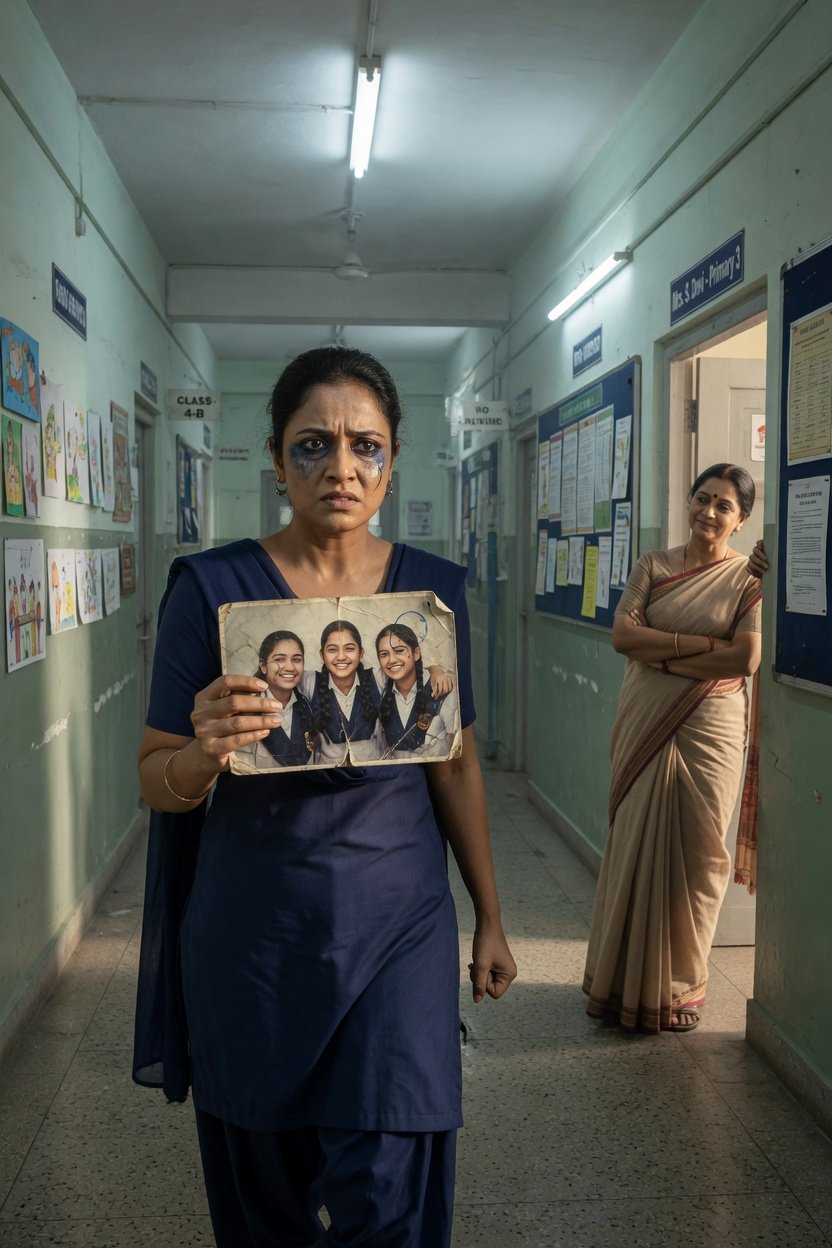
The attic was stifling, thick with the scent of aged paper and forgotten dreams, but the heat was a welcome distraction from the cold knot of fear in my gut. I rummaged through Rohan’s boxes, past old cricket trophies and faded textbooks, until my fingers brushed against the smooth, worn cover of the school yearbook from his final year. It was heavier than I expected, filled with the ghosts of youthful faces. Flipping through the pages, I scanned for Mrs. Devi’s picture, expecting to see the same fixed smile, but found something else entirely. There she was, younger, slimmer, but with the same piercing eyes, listed as ‘Miss Anjali Sharma, Class of ’95 — Vice Principal.’ And then, on the very next page, my breath hitched. A group photo of the graduating class, with Rohan front and center, smiling brightly. But it was the caption that stole the air from my lungs: “In loving memory of our three bright lights, Class of ’95: Vivek, Suresh, and Priya – lost too soon in the tragic bus accident.”
Three names. Three lost students. And tucked into the corner of that very page, a small, blurry photograph of a shrine, adorned with three small, white porcelain figurines. They weren’t dogs. They were crude, abstract human figures, easily mistaken for animals by a child. A chill ran down my spine, far colder than any draft in the attic. The “three strange white dogs.”
Further investigation, a painstaking process of cross-referencing names and dates, began to unravel a horrifying truth. Miss Anjali Sharma, now Mrs. Devi, had been a young, ambitious teacher, beloved by her students. But the bus accident, during a school trip she had organized, had claimed three of her brightest. Vivek, Suresh, and Priya. And who was driving that bus? A substitute driver, hired last minute, after the regular driver had been abruptly reassigned. Reassigned by the school principal at the time, a man named Mr. Raghavan. My Rohan’s father. My late father-in-law.
The pieces clicked into place with sickening precision. Mrs. Devi wasn’t performing a ritual for “good fortune.” She was enacting a twisted, daily penance, a silent accusation against the family she held responsible for her students’ deaths. My father-in-law had been a stickler for rules, but also known for cutting corners to save costs. Had he, in some bureaucratic oversight or cost-saving measure, contributed to the tragedy? The original school report on the accident, unearthed from old newspaper archives, mentioned faulty brakes and a driver with a questionable safety record, hastily overlooked.
I felt a cold rage harden inside me. This wasn’t harmless. This was psychological abuse, traumatizing an entire generation of children, including my daughter, Vinny, with a constant reminder of a tragedy that was not theirs to bear. And Rohan, blissfully ignorant, or perhaps willfully blind, had dismissed it all as “tradition.”
The next Monday morning, I didn’t wait for Vinny to come home. I walked straight into the school, clutching a printout of the old newspaper article and a copy of the yearbook page. Mrs. Devi was in her classroom, the cupboard door slightly ajar, the three small, white figurines gleaming faintly in the dim light. Her smile, as I entered, was as fixed and unyielding as ever.
“Good morning, Mrs. Devi,” I said, my voice steady despite the tremor in my hands. “I think we need to talk about tradition.” I placed the documents on her desk. Her eyes, usually so composed, flickered as they landed on the old photograph of Vivek, Suresh, and Priya. The fixed smile wavered, just for a moment, replaced by a flicker of raw, unadulterated grief and fury.
“These aren’t ‘dogs,’ are they, Mrs. Devi?” I continued, pointing to the figures in the cupboard. “They’re a memorial. A very specific, very cruel memorial. And the person who caused that bus crash… my father-in-law, Mr. Raghavan… he’s long gone. But you’ve turned generations of innocent children into instruments of your grief, Mrs. Devi. You’ve let your pain poison them.”
Her composure shattered. Her face contorted, a mask of bitterness replacing the false sweetness. “They need to remember! They need to understand what happens when people cut corners, when lives are treated cheaply!” she hissed, her voice low and venomous. “Your family took everything from me!”
“And you’ve been taking pieces of these children’s innocence for decades,” I countered, my voice rising. “My daughter has nightmares. Others are terrified. This stops today, Mrs. Devi. You can explain the full truth to the principal, or I will. And I assure you, my version will include all the details, from the faulty bus to your ‘ritual’ of psychological torment. This isn’t justice. This is cruelty.”
Her face was a roadmap of defeat, the weight of her long-held secret crushing her. She stared at the figures, then at the yearbook, and finally, at me, her eyes wet with tears, no longer fixed, no longer smiling. The cupboard door creaked open, revealing the three silent witnesses to her decades-long silent accusation. It was time for the truth, for everyone involved, to finally be set free.
Watch movie:

*Content is hosted on a partner site.
