
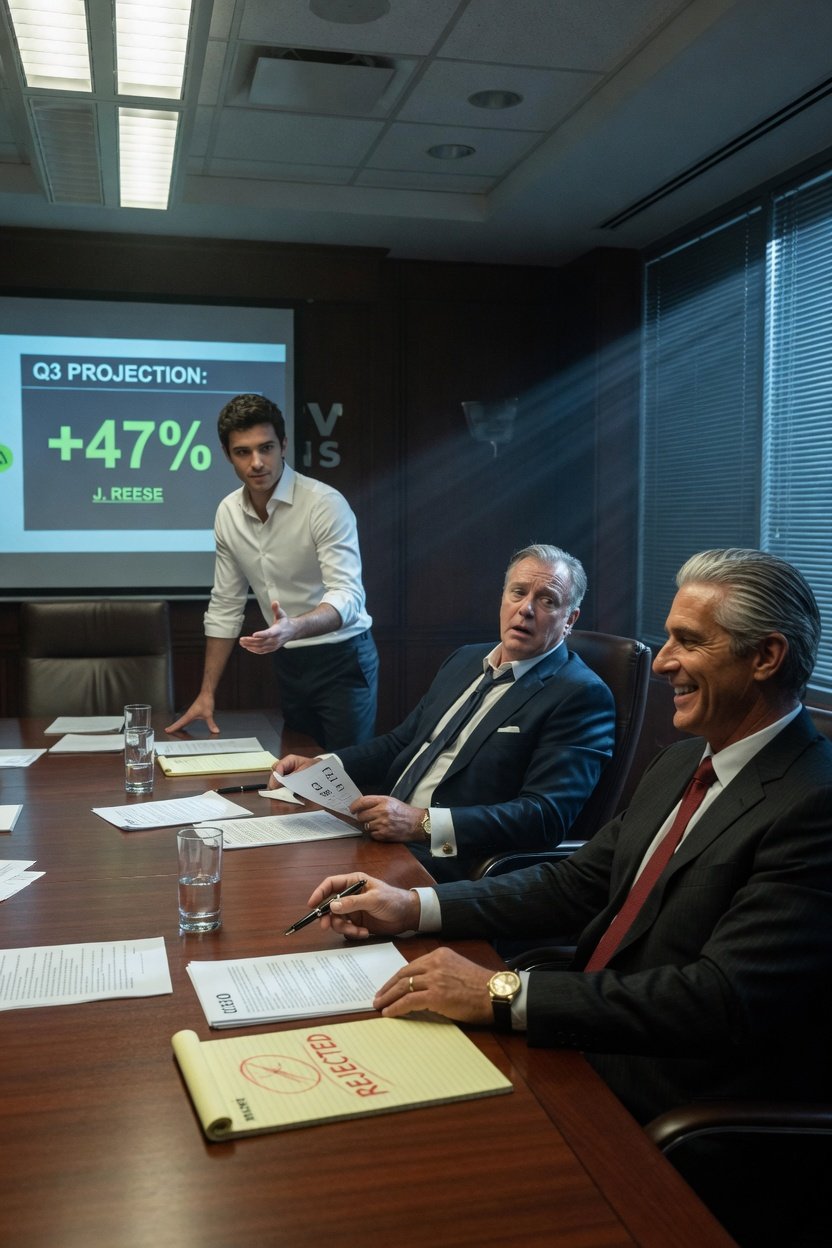
The room went deathly silent. Marcus, oblivious to the tension, continued to blather on. “As I was saying, Mr. Vance, the Aegis Protocol is my greatest achievement. If you look at the scalability metrics on slide twelve—”
“Actually,” Leo interrupted, his voice cold and sharp as a razor. He hadn’t taken his eyes off me. “I have a few questions about the core encryption layer. Marcus, you mentioned you developed the ‘paradigm shift’ yourself. Could you explain how you handled the latency issues in the polymorphic engine during the stress tests?”
Marcus froze. His mouth opened and closed like a fish out of water. He glanced at the slides, then back at Leo. “Well, you see… we utilized a standard optimization protocol… very high-level stuff. We prioritized, uh, data integrity over raw speed.”
Leo leaned back, crossing his arms. “That’s interesting, because a ‘standard protocol’ would have crashed the system under the loads you’re claiming. Alex,” Leo said, turning his full attention to me, “as the ‘junior assistant’ who handled the ‘paperwork,’ perhaps you could clarify? How did you actually resolve the entropy bottleneck in the third layer?”
I stood up slowly, the weight of six months of frustration fueling my voice. I didn’t look at Marcus. I looked at the board members, who were now watching me with sudden, intense curiosity. “We didn’t use a standard protocol, Leo,” I said, using his first name intentionally. “I wrote a custom asynchronous load-balancer that redistributes the entropy spikes across the secondary nodes. It’s based on that white paper we argued about back in senior year—the one about non-linear cryptographic distribution.”
The board members gasped. Marcus’s face turned a shade of purple I didn’t know was humanly possible. “Alex! Know your place!” he hissed. “You’re embarrassing yourself in front of our guest!”
Leo let out a short, dry laugh that echoed through the room. “The only person embarrassing themselves here, Marcus, is you. You see, I spent four years watching this ‘assistant’ build things that most of your senior engineers couldn’t even dream of. We were roommates. I’ve seen his handwriting on the original sketches for this architecture three months ago when he asked for my technical opinion.”
The Chairman of the Board, an elderly man named Mr. Sterling, leaned forward. “Is this true, Mr. Vance? Are you saying Marcus didn’t design this protocol?”
“Marcus couldn’t design a paper bag,” Leo said flatly. “He just introduced the smartest man in this room as a secretary. If this is how your company treats its actual talent while rewarding its frauds, Vance Capital isn’t interested in investing a single cent.”
The panic in the room was palpable. Mr. Sterling turned to me. “Alex, come to the head of the table. Marcus, sit in the back. And keep your mouth shut.”
For the next two hours, I gave the presentation of my life. I walked them through every detail, every struggle, and every breakthrough. Leo asked the toughest questions possible, and I answered them with the ease of someone who had lived inside the code.
When it was over, Leo stood up and shook my hand. “It’s a $50 million investment, Mr. Sterling,” Leo announced. “On one condition. I don’t invest in companies led by thieves. I want Alex as the Chief Technology Officer, and I want Marcus out of this building before I finish my coffee.”
Marcus tried to stammer an apology, but security was already at the door. He was escorted out in front of the entire office, his “visionary” reputation shattered.
After the meeting, Leo and I stayed in the boardroom. He grinned and punched me lightly on the arm. “A junior assistant, huh? You always were a terrible liar, Alex. You should have called me the moment he started stealing your work.”
“I wanted to see him dig his own grave,” I admitted, looking out the window as Marcus was led to his car. “I just didn’t realize you’d be the one providing the shovel.”
“That’s what roommates are for,” Leo laughed. “Now, let’s go get some real food. My treat. After all, you’re a CTO now.”
Watch movie:

*Content is hosted on a partner site.
