
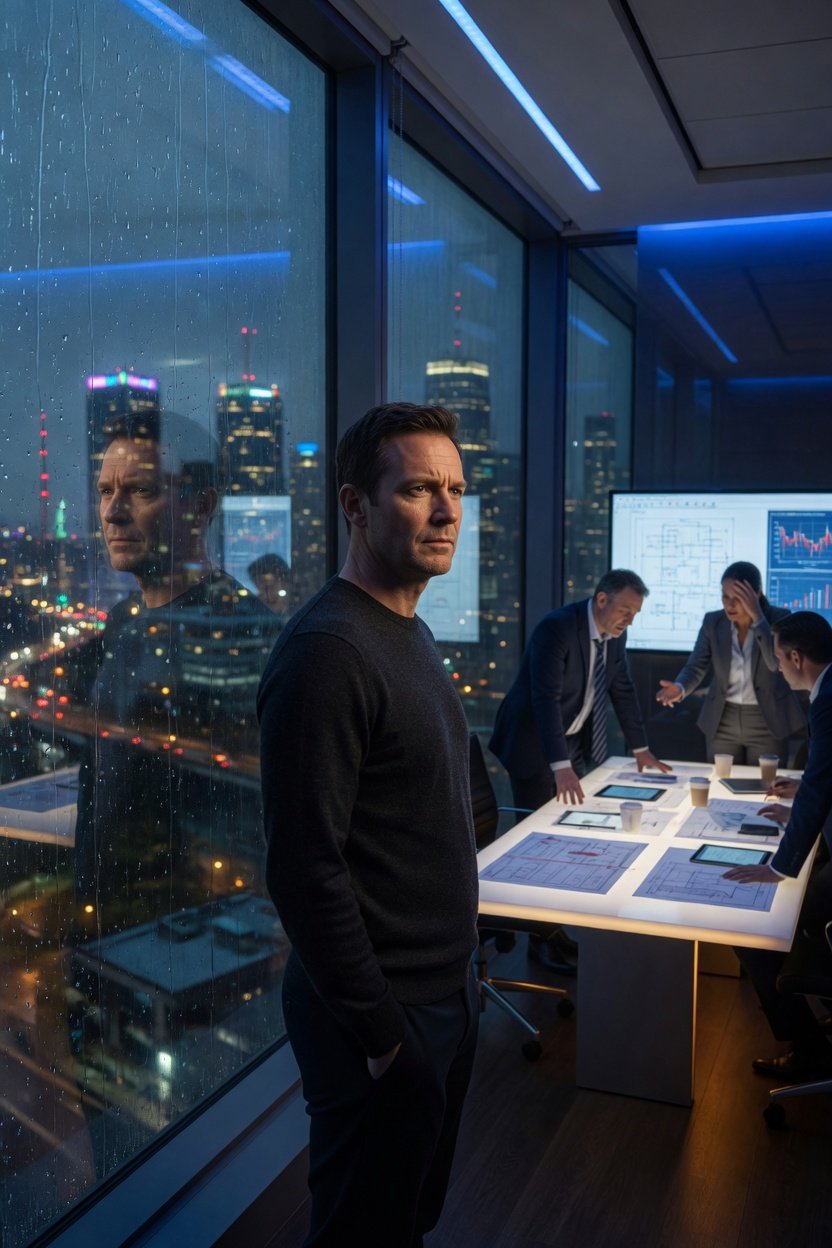
The boardroom at Zenith Dynamics looked exactly the same, yet entirely different. The mahogany table was still polished to a mirror shine, but the men and women sitting around it looked haggard. Marcus Vane sat at the head, his expensive suit unable to hide the desperation in his eyes. When I walked in, not in a suit, but in a casual sweater and jeans, the silence was deafening. I wasn’t there for an interview; I was there for a takeover.
“Thank you for coming, Elias,” Marcus started, trying to regain some semblance of authority. “As I mentioned on the phone, the Nexus-9 is facing critical thermal runaway issues. Our lead engineers—”
“The lead engineers you hired to replace me for half the salary?” I interrupted, leaning back in my chair. “I’ve seen the reports, Marcus. You didn’t just have a technical failure; you had a failure of vision. You stripped the safety protocols I designed because they added four dollars to the unit cost. You prioritized margins over integrity, and now the world knows it.”
One of the board members, a sharp-featured woman named Sarah, leaned forward. “We are prepared to offer you a salary of four hundred thousand, plus stock options, if you can fix the line within ninety days.”
I laughed. It wasn’t a bitter laugh, but one of genuine amusement. “You’re still thinking like it’s 2020. I don’t want a job. I don’t want your stock options, which, by the way, are currently trending toward junk status.”
“Then what do you want?” Marcus snapped.
“I want a partnership,” I said, sliding a contract across the table. “My consultancy firm, ‘Phoenix Systems,’ will take over the entire management of the Nexus line. You will pay a flat consulting fee of two million dollars upfront. Additionally, Phoenix Systems will receive a ten percent royalty on every unit sold for the next five years. And most importantly, I want full autonomy. That means I hire, I fire, and I dictate the engineering standards. No interference from the executive suite.”
The room erupted. “That’s extortion!” Sarah shouted.
“That’s market value,” I countered. “In forty-eight hours, the federal safety commission is going to issue a permanent ban on the Nexus-9. When that happens, Zenith’s valuation will drop by forty percent. You’ll be facing a hostile takeover or bankruptcy by the end of the quarter. My solution is the only thing that keeps this company alive.”
I stood up to leave. “You have until five PM to sign. After that, the price doubles.”
I didn’t even make it to the elevator before Marcus caught up to me. His face was flushed. “You’re enjoying this, aren’t you? Seeing us crawl?”
“I’m not enjoying your failure, Marcus,” I said, looking him dead in the eye. “I’m enjoying the fact that you finally realized that the ‘redundant’ people are the ones who actually build the world. You thought you could treat humans like disposable hardware. You were wrong.”
By 4:55 PM, the signed contract was in my inbox.
I spent the next three months living in the Zenith factory. It turned out the “unfixable” flaw was exactly what I suspected: a botched firmware update designed by a cut-rate outsourcing firm that overrode the hardware heat sinks I had pioneered. I fired the incompetent management team that had allowed the shortcut and brought back six of the senior engineers who had been laid off alongside me, offering them double their previous salaries.
We didn’t just fix the Nexus-9; we redesigned it into the Nexus-X. It became the safest, most efficient industrial tool on the market. Zenith’s stock didn’t just recover; it soared.
A year later, at the annual shareholders’ meeting, Marcus Vane was forced to announce his early retirement. The board, realizing that the company’s success was now tied entirely to my consultancy’s oversight, had no choice but to push him out. As he walked out of the building for the last time, I was standing by the entrance.
“Need a lift?” I asked, gesturing to the sleek car my royalties had paid for.
He didn’t say a word. He just kept walking.
I realized then that revenge isn’t about being mean or shouting. It’s about becoming so successful that the people who doubted you have to pay you just to stand in your shadow. I was no longer a line item on a spreadsheet. I was the one holding the pen.
Watch movie:

*Content is hosted on a partner site.
