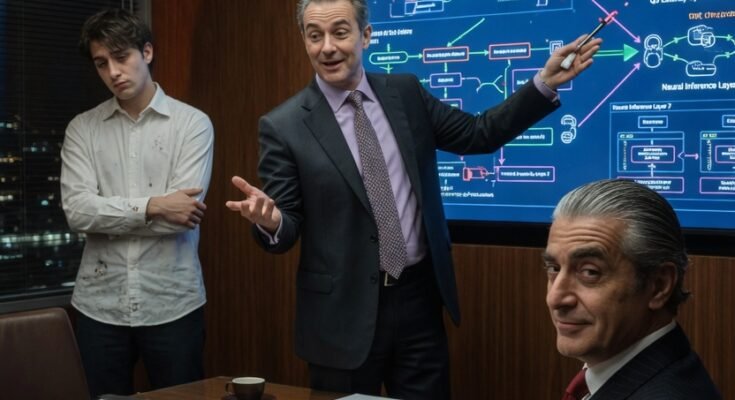
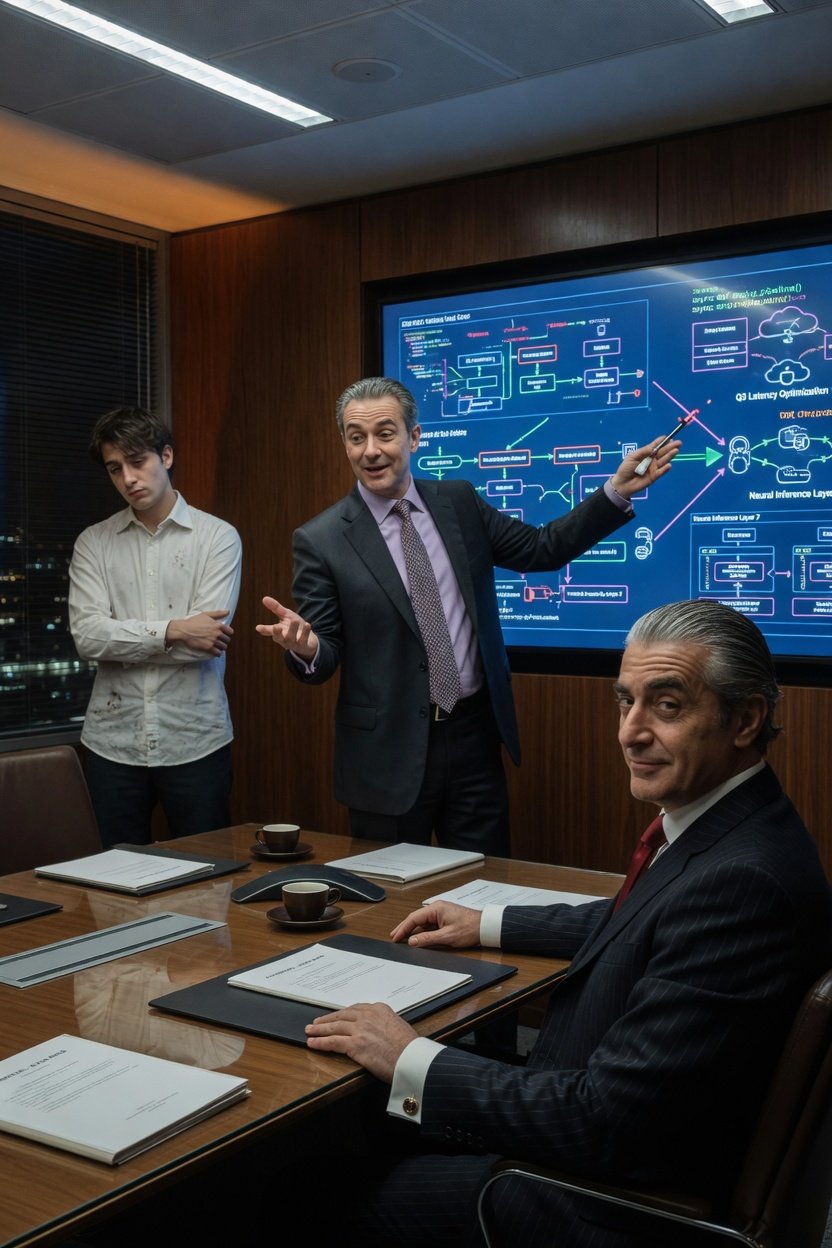
Marcus didn’t give me away immediately. He stood there, tall and imposing, his face a mask of professional neutrality. But I saw the flicker in his eyes—the same mischievous glint he had when we were sophomores pulling all-nighters in the computer lab. He looked at Arthur, then back at me, and his lips curled into a thin, dangerous smile.
“An assistant, you say?” Marcus asked, his voice smooth as silk. He didn’t take the seat Arthur offered. Instead, he stayed standing, forcing Arthur to look up at him. “It must be difficult to find someone so… capable of handling such complex administrative tasks.”
Arthur chuckled, completely oblivious to the shark circling him. “Oh, you know how it is, Marcus. Good help is hard to find, but Alex here is a hard worker. He’s just not built for the high-level strategy that Aether requires. Now, about the Series B funding—”
“Actually,” Marcus interrupted, holding up a hand. “I have a few technical questions about the Aether architecture. Specifically, the latent-space optimization on page twelve of your presentation. You mentioned it was your ‘brainchild.’ Tell me, Arthur, how did you solve the synchronization bottleneck in the multi-threaded environment?”
The room went silent. Arthur’s face turned a shade of pale that matched his expensive dress shirt. He stammered, his eyes darting to the slide deck on the screen. “Well, it’s a… it’s a proprietary process. Very complex. I used a series of… uh… dynamic buffers.”
“Dynamic buffers?” Marcus raised an eyebrow. “That would cause a memory leak in a system this size. Alex, as the man who brings the coffee, surely you’ve overheard Arthur talking about how he actually solved it? Or perhaps you have an opinion?”
The board members began to whisper. They weren’t stupid; they could see Arthur sweating. Arthur glared at me, his eyes screaming for me to stay silent. But the six months of stolen weekends and the public humiliation of being called a coffee boy boiled over.
“Actually, Mr. Thorne,” I said, stepping forward and setting my tablet down on the table. I didn’t look at Arthur. “Dynamic buffers would be a disaster. The bottleneck was solved using a decentralized semaphore logic I developed—I mean, that was developed—specifically for this kernel. It doesn’t just buffer; it reallocates processing power in real-time based on the predictive analysis of the data stream.”
I spent the next ten minutes dismantling Arthur’s ‘genius’ presentation. I explained the code, the logic, and the future scalability in a way that only the person who wrote it could. By the time I finished, the air in the room was thick with tension. Arthur was fuming, his hands shaking.
“Enough of this!” Arthur shouted, slamming his hand on the table. “Alex, you’re fired! Get out of this building right now! Marcus, I apologize for this. The help is getting a bit too arrogant these days.”
Marcus didn’t move. He looked at the Board Chairman, an older man who looked absolutely horrified. Then, Marcus turned back to Arthur.
“You’re firing him?” Marcus asked quietly. “That’s a shame. Because Thorne Ventures doesn’t invest in ‘visionaries’ who can’t explain their own vision. And we certainly don’t invest in liars.”
Marcus walked over to me and put a hand on my shoulder. “It’s been a long time, Alex. I see you haven’t lost your touch since you carried our entire senior project on your back while I was out with the flu.”
The Chairman of the Board stood up. “Mr. Thorne… what are you saying?”
“I’m saying,” Marcus announced, his voice echoing in the boardroom, “that Alex was the Valedictorian of our class at MIT. He was the head of the robotics lab and the brightest engineer I’ve ever known. If you tell me he’s just a coffee boy, then this company is clearly being run by a man who wouldn’t know talent if it hit him in the face.”
The fallout was instantaneous. The board called an emergency session right then and there. Within two hours, Arthur Sterling was escorted out of the building by security, his “brainchild” remaining firmly in my hands.
Marcus and I grabbed dinner that night—not as investor and assistant, but as friends. He didn’t just give me the funding; he helped me restructure the company. I’m no longer an assistant. I’m the CEO of Aether Tech. And as for Arthur? Last I heard, he’s looking for work. I hear he’s quite good at making coffee.
Watch movie:

*Content is hosted on a partner site.
