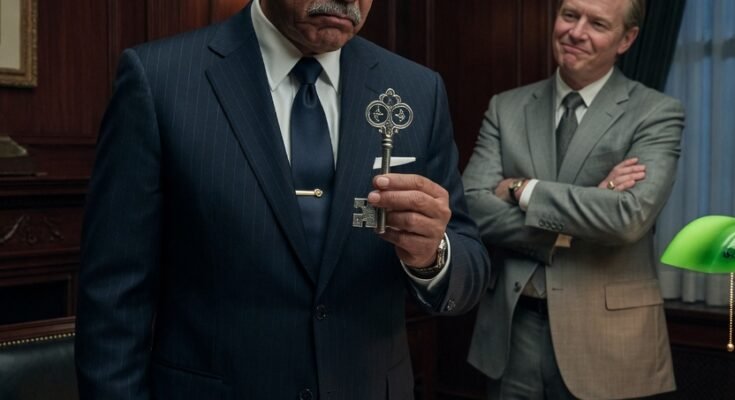
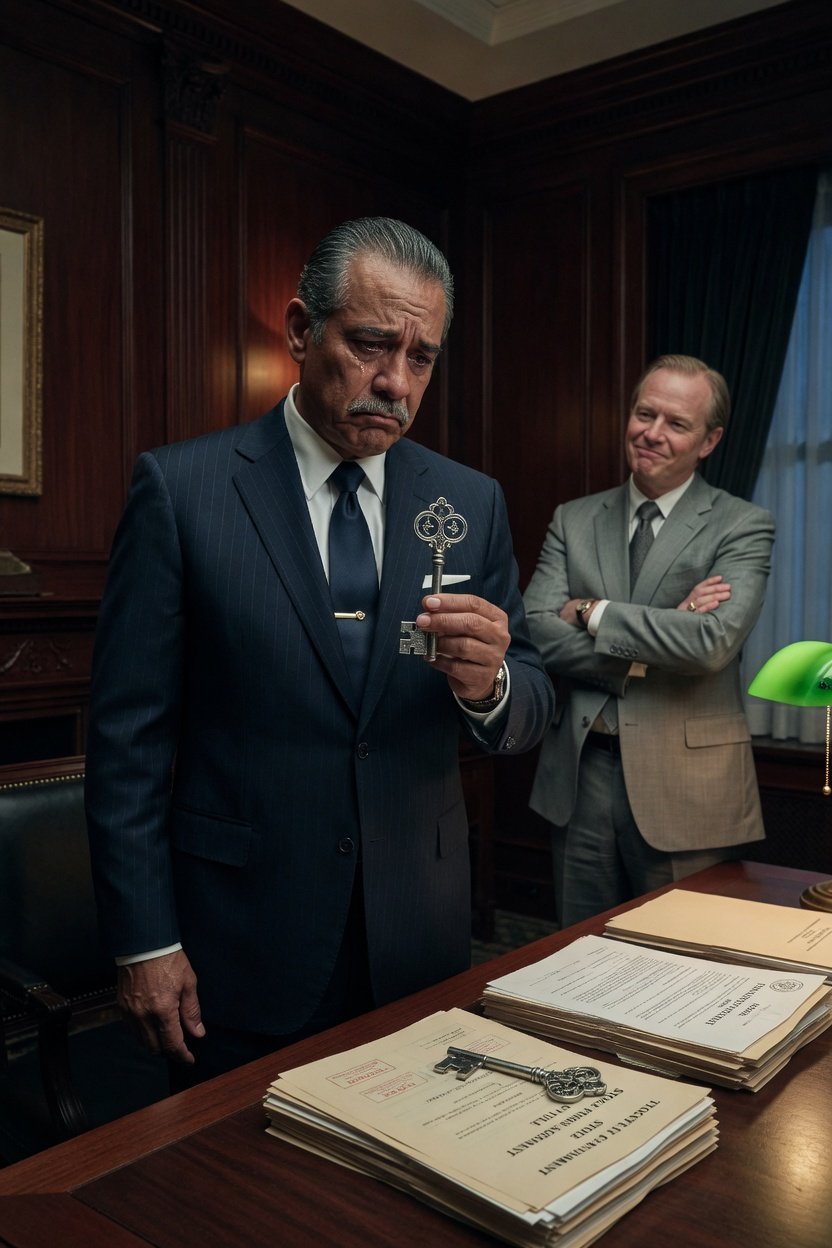
The silver key didn’t belong to the cleaning closet. It was the master key to the “Vault,” a room containing the original, unredacted records of every merger the firm had overseen for forty years. Preston thought I was just helping the charade, giving Mateo a prop to make him look more authoritative. He didn’t realize that I had spent my lunch breaks listening to Mateo talk about his daughter’s studies in corporate ethics, or that Mateo knew more about the firm’s inner workings from the documents he found in the trash than Preston knew from his law degree.
Inside the boardroom, the tension was thick enough to choke on. Sterling sat across from Mateo, puffing on a cigar that cost more than Mateo’s monthly rent. “The merger is simple,” Sterling said, sliding a gold pen across the table. “I absorb the smaller firm, I liquidate their pensions, and your firm gets a five-percent kicker. Just sign off on the ‘ethics compliance’ form, and we’re done.”
Preston stood behind Mateo, hovering like a vulture. “Go on, ‘Partner,'” Preston urged, his voice a low growl. “Sign it.”
Mateo looked at the silver key in his hand, then at the compliance form. He knew what that key opened. He also knew that Sterling’s “liquidation” of pensions would bankrupt three hundred families in the very neighborhood where Mateo lived. For twenty years, Mateo had been the invisible man, the one who cleaned up their messes—literal and figurative.
“I need to verify the source files,” Mateo said, his voice surprisingly steady. It was the most he had spoken in years.
Sterling laughed. “Verification? At this stage? You really are a stickler, aren’t you? I like that.”
Preston tried to intervene. “That won’t be necessary, Mateo—”
“I cannot sign without the Vault files,” Mateo interrupted, standing up. He used the silver key to open the private door leading directly to the records room. Preston couldn’t stop him without admitting the janitor was in the restricted archives.
Ten minutes later, Mateo returned, not with the compliance form, but with a dusty ledger from 1994. He laid it open in front of Sterling. “Mr. Sterling,” Mateo said, his Spanish accent slightly more pronounced now, no longer hiding. “According to these records, your father didn’t buy the land for your first factory. He stole it from a community trust. A trust that my grandfather was a member of.”
The room went silent. Sterling’s face turned a violent shade of purple. “What is this? Preston, who is this man?”
Preston was sweating through his thousand-dollar shirt. “He’s… he’s just…”
“I am the man who has cleaned your toilets for twenty years,” Mateo said, tossing the silver key onto the mahogany table. It landed with a sharp, metallic ring. “And I am also the man who just sent a digital scan of these ledgers to the State Attorney’s office using the terminal in that room.”
Sterling lunged for the ledger, but Mateo was faster, pulling it back. “You wanted a partner with ‘breeding,’ Mr. Sterling. But it turns out, all you needed was someone who wasn’t afraid of the dirt.”
The fallout was instantaneous. The merger collapsed within the hour as news of the fraud investigation leaked. Sterling was indicted three days later. Preston tried to fire Mateo, but he couldn’t. I had filmed the entire interaction from the doorway, including Preston’s threat about the tuition and his admission that he was deceiving a client.
Mateo didn’t stay, though. He didn’t need to. The whistle-blower reward from the state was more than enough to pay for his daughter’s tuition and then some. On the day of her graduation, I saw him in the front row. He wasn’t wearing his janitor’s uniform, and he wasn’t pretending to be a partner. He was just a father, watching his daughter walk across the stage to receive her law degree.
As for the firm, Sterling & Associates went under within six months. It turns out that when you build a house of cards, the person who knows best how to knock it down is the one who’s been sweeping the floors around it all along.
Watch movie:

*Content is hosted on a partner site.
