
The purchase of the lot took exactly three weeks. Because the land was zoned for “Mixed-Use/Light Commercial,” most residential buyers had stayed away from it, fearing the lack of privacy. To Arthur, it was a buffer zone he assumed would stay empty forever. He had spent years treating that land like his own personal extended yard, even planting a few rose bushes on it.
When the “Sold” sign finally appeared, Arthur actually came to my door with a bottle of cheap wine. He thought I had bought it to “improve the neighborhood” or perhaps to build a playground for Lily. “I’m glad you finally saw reason, Sarah,” he said, his voice dripping with condescension. “It’ll be nice to have a beautiful garden there instead of weeds. Just keep the construction noise within the legal hours, alright?”
I didn’t open the wine. I didn’t even invite him in. I just smiled—a cold, thin smile that seemed to make him blink in confusion—and said, “Oh, I’m not building a garden, Arthur. I’m building an investment.”
Two days later, the heavy machinery arrived. Not for a house, but for something much more specific. I had spent the last twenty-one days studying the local zoning laws with the precision of a diamond cutter. In our specific sub-district, there was a loophole: any property zoned as Mixed-Use could be utilized for “essential community service facilities” without a public hearing, provided the footprint was under a certain square footage.
I didn’t build a house. I built a “24-Hour Express High-Suction Self-Service Vacuum and Car Wash Station.”
The legal battle began the moment the first industrial vacuum was bolted into the concrete pad, exactly ten feet from Arthur’s master bedroom window. Arthur was livid. He called the police, but this time, it wasn’t Officer Miller who showed up. It was a county inspector who looked at my perfectly filed permits and my commercial zoning license. “Everything is in order here,” the inspector told a purple-faced Arthur. “It’s her land. She has the right to operate a business.”
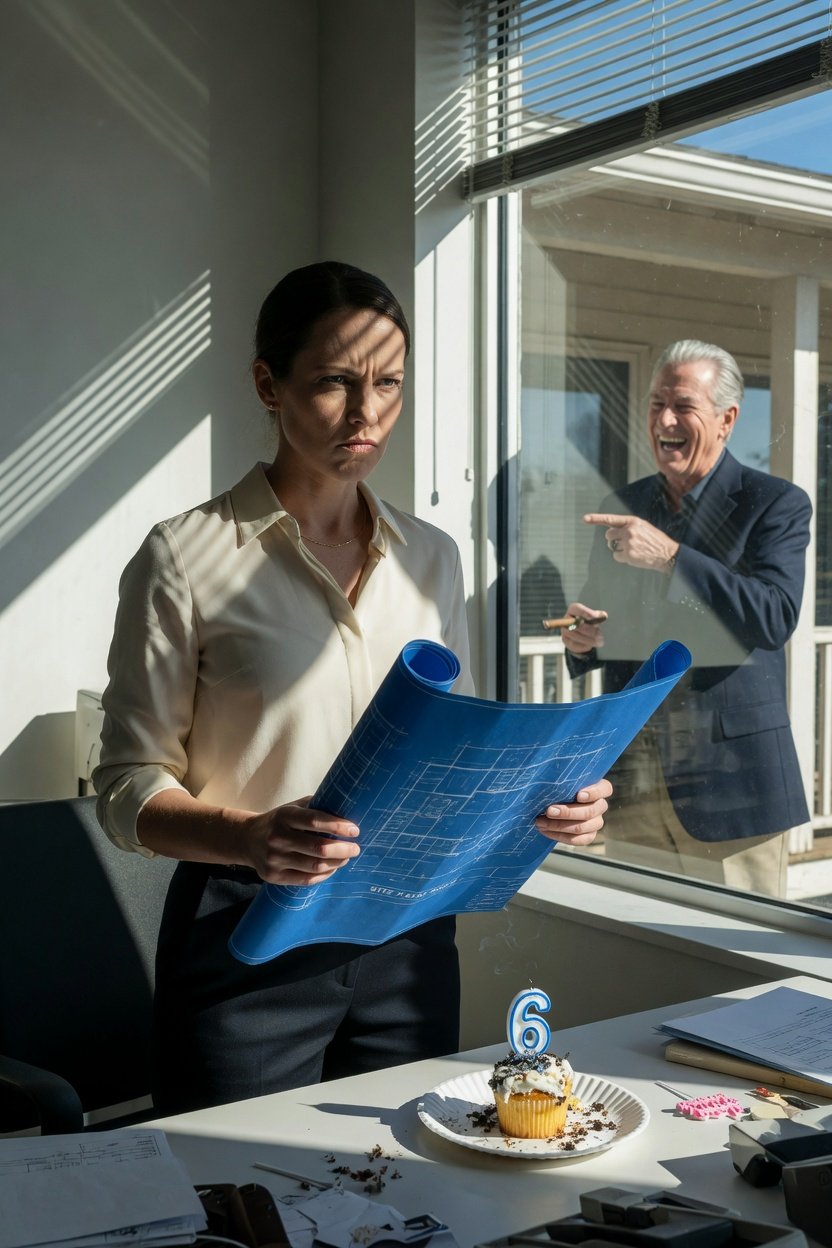
Arthur tried to sue for “noise pollution.” I simply brought the citation he had called on my daughter’s birthday to the court. I showed the judge the decibel readings. My car wash vacuums operated at exactly 65 decibels—the legal limit for a commercial zone. It was a constant, low-frequency hum, punctuated by the high-pitched whine of the suction nozzles. It wasn’t “uncontrolled juvenile screaming.” It was “the sound of industry.”
Because it was a 24-hour facility, the lights were another factor. I installed high-intensity, motion-activated LED floodlights. Every time a car pulled in at 2:00 AM for a quick vacuum, Arthur’s entire bedroom would light up like a stadium.
David tried to beg me to stop. “Sarah, this is insane. You’re spending so much money just to spite him.”
“It’s not just spite, David,” I replied, looking him dead in the eye. “It’s an education. I’m teaching Lily that when someone tries to silence your joy, you make sure they never know peace again.”
After six months of sleep deprivation and failing to find a single lawyer who could bypass my airtight permits, Arthur broke. He couldn’t sell his house; no one wanted to live next to a 24-hour car wash. The value of his “estate” plummeted by forty percent.
One Tuesday morning, I saw a moving truck in his driveway. Arthur was loading boxes, his eyes sunken and dark. He looked like a ghost of the man who had smugly watched my daughter cry. He walked to the edge of the fence, looking at the gleaming metal vacuums that were currently being used by a teenager with a very loud muffler.
“You ruined me,” he croaked.
I leaned against the fence, the same fence he had leaned over to insult my child. “The law is the law, Arthur,” I said quietly. “I’m sure you understand.”
The day he moved out, I closed the business. I didn’t need the money. I had the land cleared and donated the lot to the city under one condition: it had to be turned into a public “Musical Exploration Park” for children. Today, the lot is filled with giant outdoor xylophones, metal drums, and chimes that ring in the wind. It is the loudest, most joyful place in the neighborhood. And every time I hear the clanging of the drums, I think of Lily’s 6th birthday, and I smile.
Watch movie:

*Content is hosted on a partner site.
