
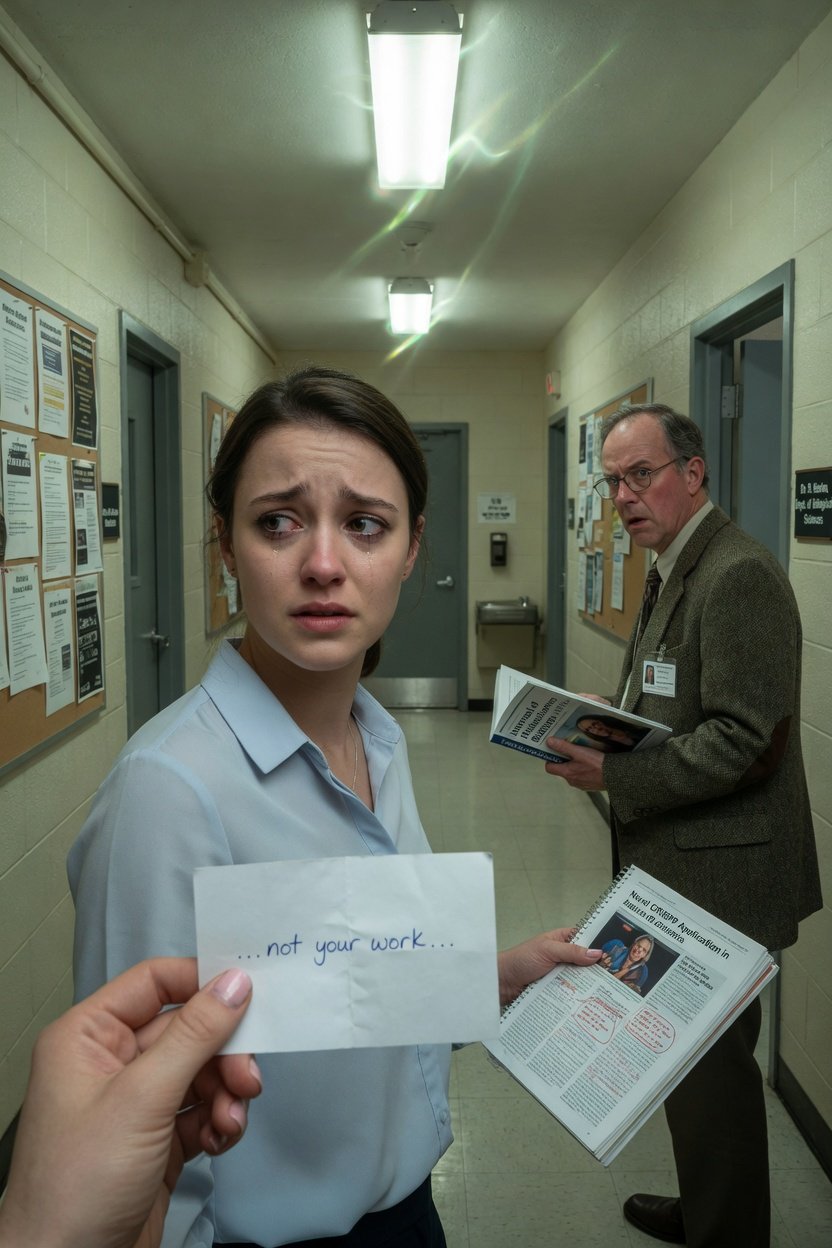
The Monday morning sun, usually a cheerful harbinger of a new week, seemed to cast a particularly harsh light on Professor Sterling’s office door. My heart pounded, a drumbeat of anticipation and cold satisfaction, as I approached. I clutched the package – a padded envelope containing the latest issue of the *Journal of Post-Colonial Studies*, open to the contents page where my article was listed, and a single, perfectly folded note tucked inside. I slid it through the mail slot, a silent declaration of war delivered with surgical precision. The thud as it landed on the floor inside was surprisingly loud in the quiet hallway. I turned and walked away, not looking back, a ghost of a smile playing on my lips.
The waiting was the hardest part. I saw Sterling at various department meetings throughout the week, but he offered no acknowledgment, no change in his usual pompous demeanor. He looked as dismissive as ever, lecturing colleagues on the “decline of academic standards” with a theatrical flourish of his hand. Was he ignoring it? Had he not even opened it? The thought sparked a momentary flicker of doubt, but it was quickly extinguished. He would have seen it. The article was too prominent, the note too deliberate. His silence was not ignorance; it was a carefully constructed defense, a fragile wall against a truth he couldn’t bear to face.
The true moment of reckoning came three days later, during a faculty lunch. I was sitting with my advisor, Professor Anya Sharma, who gave me a knowing, conspiratorial wink. Sterling entered the dining hall, his usual boisterous laugh noticeably absent. His eyes, usually scanning the room for an audience, darted nervously. He picked at his food, a furrow deeply etched between his brows. His usual bravado had evaporated, replaced by a sullen quietude. It was a subtle shift, imperceptible to most, but to me, it was as loud as a shout. He knew.
Later that afternoon, my phone rang. It was Professor Sharma. “He knows,” she confirmed, her voice barely a whisper, a thrill of quiet triumph in her tone. “Apparently, he left the journal open on his desk for everyone to see, almost daring someone to comment, then retreated to his office for half the day. The article title, your name… it’s been the topic of hushed whispers. He’s furious, of course, but he can’t say a word without admitting his colossal error. It’s beautiful, isn’t it?”
A few weeks later, the university announced a new initiative to promote interdisciplinary research, with a specific focus on areas often deemed “niche,” like post-colonial studies. Sterling, surprisingly, was conspicuously absent from the inaugural committee. His lectures became less frequent, his grand pronouncements replaced by a quieter, almost withdrawn demeanor. The incident became an unspoken legend within the department – a student’s quiet victory over an arrogant professor. The D grade on my transcript remained, a curious anomaly in a string of A’s, but it no longer held any power. It was a scar, yes, but also a badge of honor, a testament to resilience and the quiet, potent power of a single, well-placed note. I saw Sterling in the hallway once, our eyes met. He looked away first, his face a mask of carefully controlled shame. The silence was deafening, and for the first time, it was on my terms. My note hadn’t just sent him a copy of my article; it had sent a message, loud and clear, that some ideas, and some students, could indeed have the gravitas to make an impact, even when dismissed by those who should have known better. The impact, I realized, was far greater than a simple letter grade could ever quantify. It was a ripple effect, a quiet revolution that started with a D, and ended with a national publication. And it had cost him more than just face; it had cost him his unchallenged authority. My final semester passed without another word from him, and when I graduated, my thesis committee, including a beaming Professor Sharma, celebrated my paper’s continued success, never mentioning Professor Sterling. He never did acknowledge my success, but his silence spoke volumes. It was the loudest apology I could have ever received.
Watch movie:

*Content is hosted on a partner site.
