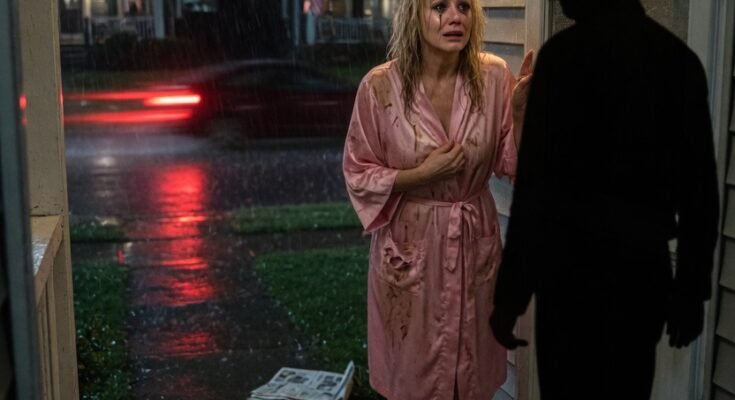
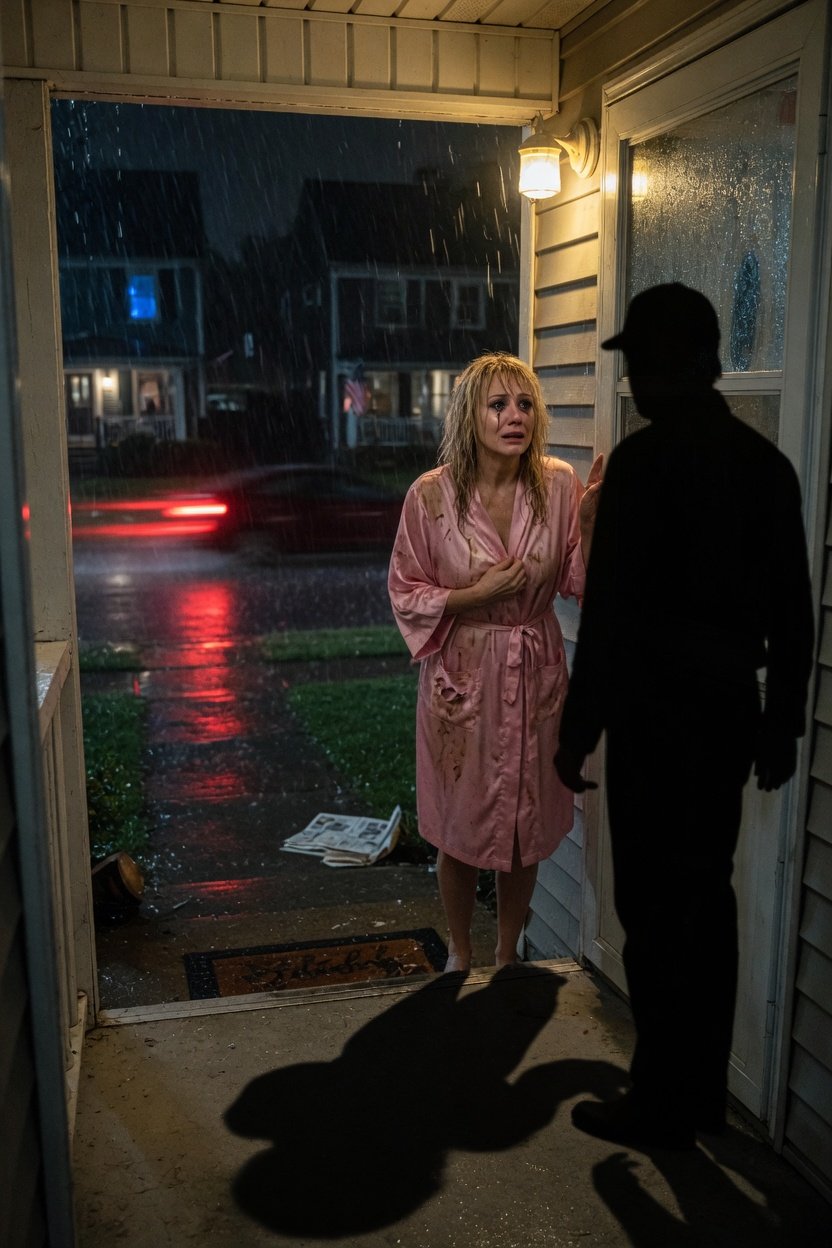
I stood there for a long beat, the cold night air rushing into my hallway and chilling my bones. Part of me—the petty, exhausted part that had paid for three different “lawn height” violations in a single month—wanted to laugh in her face. I wanted to tell her to go eat one of the “unauthorized” roses she had complained about so bitterly. I wanted to slam the door and finally enjoy the silence of her defeat. But looking at her, the sheer fragility of her posture and the way her hands clutched at the air for stability silenced my spite. This wasn’t the HOA Queen; this was a broken woman.
I stepped aside and gestured for her to enter my home. Evelyn walked in like a ghost, her bare feet dragging on my hardwood floor, leaving faint smudges of dirt. I led her to the kitchen, where she collapsed into a chair, looking small and withered. I didn’t ask questions yet. I simply went to the stove, heated up a large bowl of leftover lasagna, and poured her a glass of cold water. She ate with a desperation that was painful to watch, her hands trembling so much the fork clattered against the ceramic plate. She didn’t look up once until the plate was clean.
Once she had finished, the story tumbled out like a dam finally breaking under too much pressure. Arthur wasn’t the quiet, successful businessman the neighborhood admired. He was a meticulous, controlling tyrant who viewed his wife as just another asset to be managed, polished, and kept in line.
“The reports,” she whispered, staring into the depths of her empty glass as if searching for an escape. “They weren’t my idea. Arthur was obsessed with the neighborhood’s perceived prestige. He believed that our property value was tied to his own self-worth. He would sit at the kitchen table every Sunday evening and dictate the complaints to me. He made me watch you through the window with a stopwatch. If I refused, if I said you were just a person living your life, he would… he would punish me.”
She slowly pulled back the sleeve of her robe, revealing a purplish bruise blooming across her forearm. “He said if the property values dipped even a fraction of a percent because of unkempt houses, it was my failure as a wife. Tonight, he told me he found someone younger, someone who respected the rules better and wouldn’t argue with him. He cleared the bank accounts, took the car keys, and told me the house was in a trust I had no access to. He left me with nothing but the clothes on my back and a pantry he’d kept locked for weeks to control my discipline.”
The weight of her words settled heavily in the room, making it hard to breathe. All those years of being the neighborhood villain, and she had been a prisoner in a gilded cage just fifty feet away from me. The thirty-seven reports weren’t acts of malice; they were the desperate, forced actions of a woman trying to survive the wrath of a monster. My anger vanished, replaced by a cold, sharp clarity.
“I’m so sorry,” she sobbed, burying her face in her hands, her shoulders heaving. “I’ll move out as soon as I can. I’ll go to the HOA board and tell them it was all lies, that I made it all up. Just… please don’t call the police yet. I just need a moment to think, to find somewhere to go.”
I sat down across from her and reached out, covering her shaking hand with mine. “I’m not calling the police on you, Evelyn. But we are going to call them on Arthur. And then, we’re going to call the best lawyer in the city.”
Over the next few months, the dynamic of our street shifted entirely. I didn’t just give her a meal that night; I gave her a witness and a safe harbor. My accordion file of HOA complaints, once symbols of my frustration, became crucial evidence of Arthur’s pattern of obsessive, controlling, and abusive behavior. During the discovery phase of her divorce, we found out that Arthur had been more than just a bully; he had been skimming funds from the HOA board’s reserve accounts for years, using his position of influence to cover his tracks.
The neighborhood, once intimidated by the Sterlings, rallied around Evelyn once the truth came to light. I helped her find a job at the local library, and for the first time in her life, she had her own paycheck. The ceramic gnome stayed on my porch, and for my birthday, Evelyn bought me a second one to match it—a “friend” for the first one, she called it.
One sunny afternoon, as we sat on her front porch—which was now slightly less perfect but much more lived-in with actual flowers and messy gardening tools—she handed me a final envelope. I braced myself, an old reflex from two years of harassment. I opened it to find a handwritten note on simple, yellow paper.
“Report #38,” it read. “The neighbor in 4B is the only reason I am still standing. Thank you for showing me what a real neighbor looks like.”
I looked out at the street, where the hedges were a little too high and the grass wasn’t quite the right shade of green, and I realized that for the first time, our neighborhood actually looked like a home.
Watch movie:

*Content is hosted on a partner site.
