
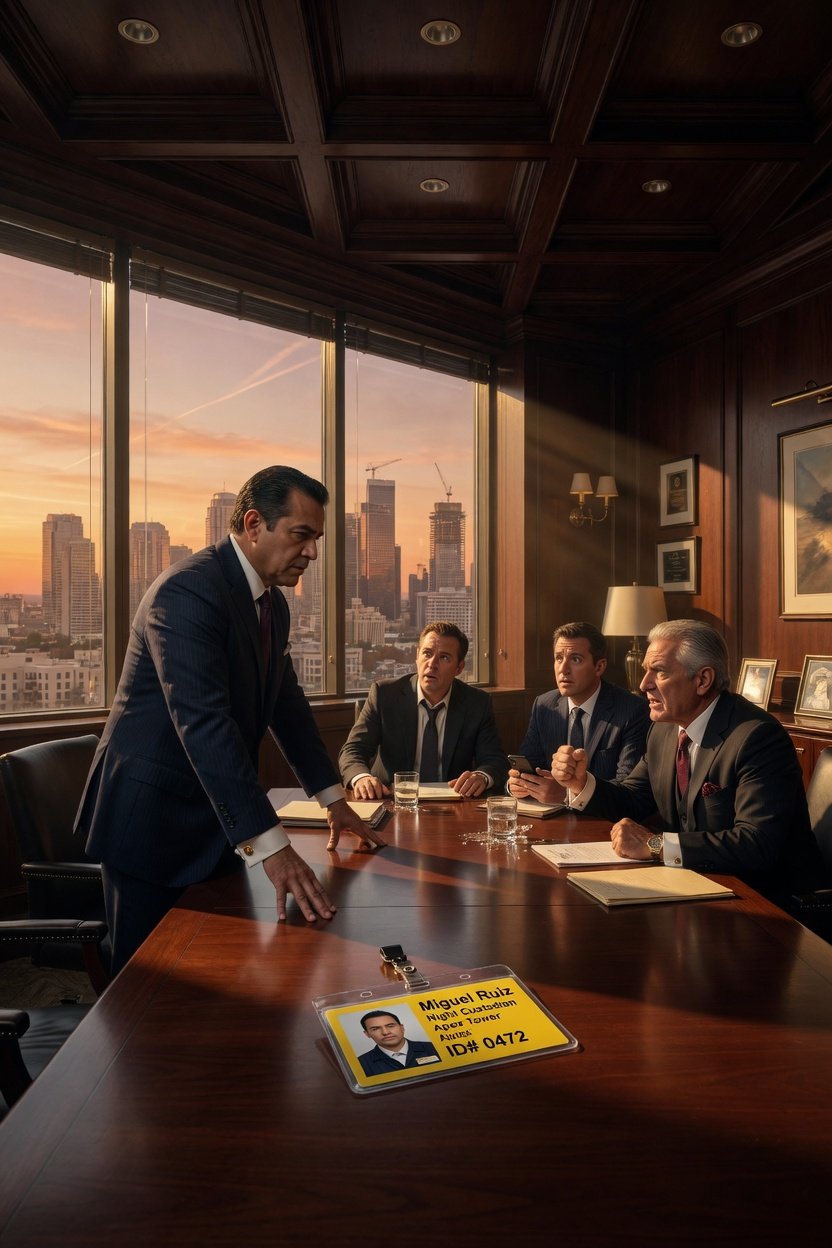
The next three hours were a blur of adrenaline and sheer terror. Mateo sat at the head of the table, the weight of the $2,000 suit feeling like lead. Sterling and Hunt flanked him, sweating through their shirts as they frantically passed him notes under the table. But Thorne wasn’t interested in the notes. He wanted to talk strategy, and he wanted to talk it with the man he thought was a Spanish aristocrat.
Thorne leaned forward, his eyes narrowing. “The union at my Ohio plant is demanding a twenty percent raise. I want them crushed. I want them out on the street by Monday. How do we bypass the federal labor regulations without triggering an audit?”
Sterling began to stammer a complex legal loophole, but Thorne silenced him with a wave of his hand. “I asked the Spaniard,” he snapped, pointing at Mateo.
Mateo looked at the man. He thought of his own brothers, cousins, and friends who worked in plants just like Thorne’s. He thought of the times he had hidden in the supply closet at this very firm to eat his lunch so he wouldn’t be seen by the “important people.” He knew more about labor laws than Sterling realized—not because he had studied them, but because he had lived them. For years, he had listened to the partners discuss how to exploit the very people Mateo went home to every night.
“Mr. Thorne,” Mateo said, his voice surprisingly steady. “You don’t want to bypass the regulations. If you do, you’ll trigger Section 402 of the Labor Relations Act, which will lead to a mandatory federal oversight. You’ll be tied up in court for a decade.”
The room went dead silent. Sterling and Hunt stared at Mateo in shock. He was right. It was a niche detail from a case they had lost three years ago—a case Mateo had witnessed from the corner of the room while buffing the floors.
Thorne grinned, slapping the table. “Brilliant! See? This is why I pay for the best.”
But the victory was short-lived. Thorne leaned back, his expression turning ugly. “It’s about time we had some real men in charge again. These days, every time I turn around, there’s some Mexican immigrant trying to take a piece of my pie. You know what I mean, don’t you? People who don’t understand the value of a dollar because they’ve never earned one.”
The air left the room. Sterling and Hunt looked at their shoes, refusing to meet Mateo’s eyes. They were willing to let their friend and employee be insulted to his face as long as the check cleared.
Mateo felt a cold clarity wash over him. He stood up slowly, unbuttoning his expensive jacket. “Actually, Mr. Thorne, I know exactly what you mean. I know the value of a dollar better than anyone in this room. I know it takes exactly four hours of scrubbing toilets to earn enough to buy the lunch you just stepped on.”
Thorne frowned. “What are you talking about?”
Mateo reached into his pocket and pulled out his janitor’s badge, the one with his photo and the word ‘MAINTENANCE’ in bold red letters. He slid it across the mahogany table until it rested right on top of the $500 million contract.
“My name is Mateo Vega,” he said, his voice echoing in the plush room. “I have cleaned this office for fifteen years. I am not a Spanish aristocrat. I am a Mexican immigrant. And I am the man who just saved your company from a federal lawsuit.”
Thorne’s face turned a shade of purple that looked like a stroke in progress. He turned to Sterling, his voice a low, vibrating growl. “Is this true? You put a… a janitor in front of me?”
Sterling scrambled for an excuse. “Arthur, please, it was just a misunderstanding, he was dressed for—”
“It’s over,” Thorne roared, standing up so fast his chair flipped. “I’m taking my business to your rivals. And I’ll make sure the Bar Association hears about this fraud!”
After Thorne stormed out, the silence in the boardroom was suffocating. Sterling turned on Mateo, his face twisted in rage. “You’re finished, Mateo. Do you have any idea what you’ve done? You’ve destroyed this firm!”
Mateo didn’t flinch. He looked at the man he had served for over a decade. “No, Mr. Sterling. You destroyed it the moment you decided my dignity was worth less than a signature. I’m not finished. I’m going to my daughter’s graduation. She’s the one who’s going to be the real lawyer. And when she’s done, she’ll never have to pretend to be someone else just to be heard.”
Mateo walked out of the boardroom, leaving the $2,000 jacket on the back of the chair. He walked past the supply closets, past the vacuum cleaners, and out the front doors into the bright afternoon sun. He was unemployed, he was broke, but for the first time in fifteen years, he was walking with his head held high.
Watch movie:

*Content is hosted on a partner site.
